


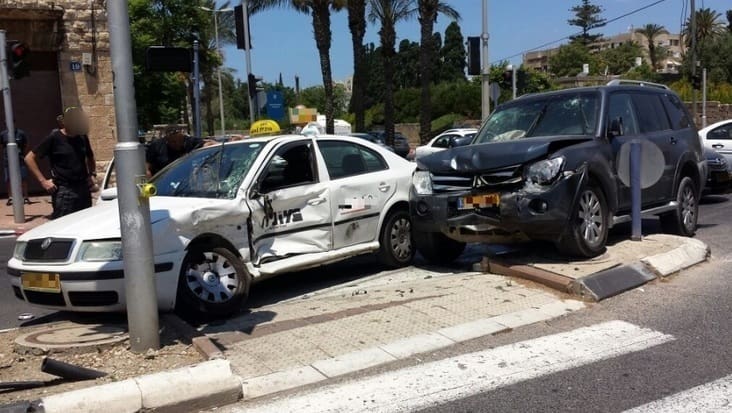
(Hai Fa – Haifa and the surrounding area news corporation) – More than four people are seriously injured every day in road accidents on urban roads in Israel. In 2025, 1,560 people were seriously injured in accidents in cities, and Haifa is among the cities where hundreds of casualties were recorded in the last decade. The city had 76 people seriously injured in 2025, the same figure as in 2024. The Or Yarok NGO warns of the ongoing failure to reduce the number of casualties and calls for the approval of a multi-year national road safety plan.
Every day, the media publishes reports about someone who has been seriously injured in a car accident. Sometimes the difference between a serious injury and the loss of life is only a split second. But behind the brief reports lies the harsh reality of thousands of people dealing with serious injuries, long rehabilitation periods, and sometimes even lifelong disability.
Data from the Or Yarok Association, based on data from the Central Bureau of Statistics, indicates that in 2025, 1,560 people were seriously injured in road accidents on urban roads in Israel, more than four people on average every day.
This is the second worst year in the last decade in terms of the number of people seriously injured in accidents in cities. In 2024, 1,624 people were seriously injured, so in 2025 there was a decrease of only about 4%.
In Haifa: 76 seriously injured in one year
Data from Haifa also indicates a significant number of road accident victims. In 2025, 76 people were seriously injured on the city's roads, the same number as in 2024.
Looking at the last decade, between 2016 and 2025, the picture is even more worrying: 818 people were seriously injured in road accidents in Haifa. This includes hundreds of residents and people who passed through the city and were seriously injured on the roads over the years.
The data places Haifa among the cities with a high number of seriously injured people, and highlights the need to continue addressing road safety in the urban area.
Green Light: "The failure to reduce the number of seriously injured people is major and complete"
Attorney Yaniv Yaakov, CEO of the Or Yarok Association, warns that focusing solely on the number of fatalities does not reflect the full extent of the harm caused by road accidents. He says that the number of seriously injured people must also be considered a key indicator in examining the state of road safety in Israel.
"Sometimes the difference between a fatality and a serious injury is a hair's breadth. Sometimes it's just a matter of luck. The fatality rate is a leading rate, but we must also consider the internationally accepted serious injury rate, and unfortunately Israel's failure to reduce the serious injury rate is great and complete."
He said that a serious injury in a car accident does not end when the victim is evacuated to the hospital. For many of the injured, it is the beginning of a long and complex rehabilitation process, which also affects family members and is sometimes accompanied by coping with a lifelong disability.
Yaakov also links the data to the reduction in budgets allocated to the fight against road accidents, and calls on the next Minister of Transportation and Road Safety to approve the multi-year national road safety plan.
He said that implementing the plan could lead to a reduction in the number of seriously injured people and prevent prolonged suffering for the injured and their families.
Israel is far behind compared to European countries
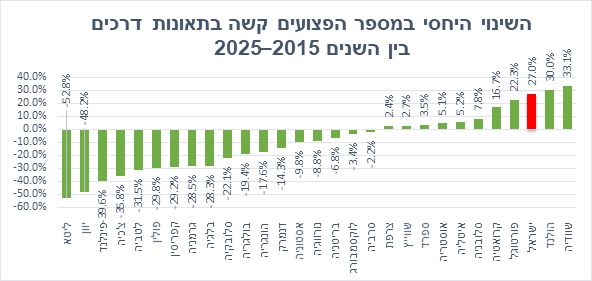
The worrying data is not limited to urban roads. An international comparison conducted by the Or Yarok association, based on CBS data, places Israel in third place from the bottom in the relative change in the number of seriously injured people in road accidents between 2015 and 2025.
According to the data, in 2015, 2,174 people were seriously injured in road accidents in Israel, compared to 2,761 in 2025. This is an increase of 587 seriously injured people, about 27% within a decade.
For comparison, European countries recorded an average decrease of 12.4% in the number of people seriously injured in road accidents during the same period. While European countries recorded an average annual decrease of 1.8%, Israel recorded an average annual increase of 2.4%.
In the country rankings, Israel is in third place from the bottom, with Sweden ranked last and the Netherlands in second to last.
National Road Safety Plan – Can No Longer Be Postponed
The Or Yarok Association emphasizes that many European countries have succeeded in reducing the number of deaths and serious injuries through long-term policies, improved infrastructure, effective enforcement, and investment in education and outreach.
The gap between the trend in Israel and the trend in European countries, according to the association, highlights the need for policy change and continued investment in road safety.
In Haifa, where 76 people were seriously injured in 2025 and 818 in the last decade, the data illustrates that behind every number stands a person whose life has changed, and sometimes an entire family that is forced to deal with the consequences of the accident.
The fight against road accidents is not measured only by the number of fatalities. Reducing the number of serious injuries, preventing disability, and reducing the suffering of the injured are also an integral part of the need to make Israel's roads safer.
Another deadly year. As early as November 24, 2026, we reached 400 deaths a year in road accidents. Last year there were 460, this year we will probably end with 430-440. Crazy numbers, of course not including 2000 seriously injured people who require prolonged rehabilitation. The cost to the economy is tens of billions of shekels in damages. We continue to flood the roads every year with 300,000 additional vehicles and only 50 are being towed.
This is a nightmare disaster. Anyone who drives in Haifa already understands that this is not about to be a disaster – it is already in the middle of the event.
Worst of all, unlike Jerusalem and Tel Aviv, there is no plan to promote public transportation in Haifa. Nothing, it's shocking. No forward-thinking horizon.