


"At first, it was very difficult to even convince a child to wear a wetsuit. The suit clings to the body, sometimes gets wet, and it can be very difficult for a child to keep going."
But with each child they worked slowly, with utmost attention, one step at a time.
"Today all the kids are wearing wetsuits. Last Sunday we put them all in the water, and they were on SUPs." Standing on a SUP and paddling with an oar requires coordination that is not easy, even for adults. "When you see kids who managed to stand, paddle, break free and see that they are capable, it's an amazing moment."
I decided to start with this little story, which David told me, a story about the transformation of a child who has difficulty with an action that seems simple to us, putting on a wetsuit, and gradually develops the ability to perform much more complex actions, because it contains insights into the way we develop as humans. How do we deal with fear? How do we develop strengthening habits? And how can one person establish a social enterprise that does good for others?
The children moved on – David stayed.
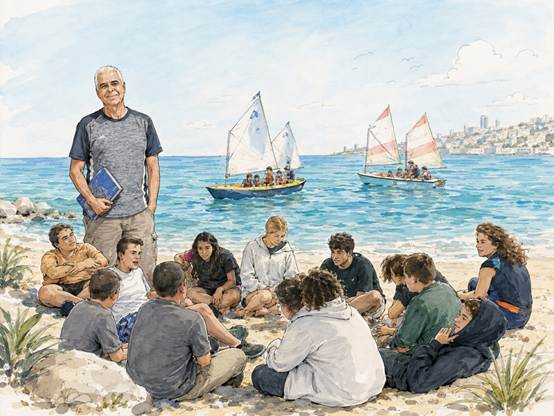
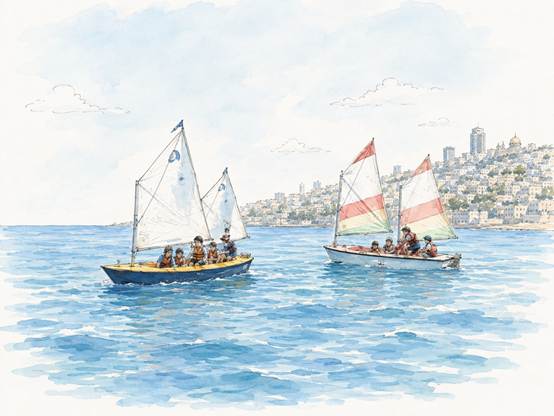
"About twenty years ago, I was a sailing enthusiast, and I had a boat that I would sail with. When my children were little, I wanted to teach them to sail on boats that were appropriate for their age," is how David began his story.
A story that started as a hobby and a desire to teach children, and evolved into an inspiring social educational project that teaches children on the spectrum to believe in themselves and be able to lead independent lives.
David Habub, married and a father of three from Neve Sha'anan, was working at Bank Hapoalim at the time. He began his journey in Zevulun Haifa, developing a popular sailing group that grew by word of mouth through friends and acquaintances.
"The place itself was amazing, with great access to the sea, but it was in great disrepair. Everything was dilapidated and falling apart, there weren't enough boats, and the feeling was more of an abandoned warehouse than a sailing club. I looked at the place and said to myself: You could create an amazing place here."
Together with good people from Bank Hapoalim and other friends, he managed to bring in donations, thanks to which he purchased boats specifically for public boating activities. It moves me to hear how one person's dream and vision can change reality, connect people, and transform a neglected place into a place that is flourishing and vibrant with life.
But, then came the turning point. David's children grew up and became interested in other things and did not continue to sail with him.
David stayed.
His love of sailing and educating children led him to focus his activities on at-risk youth and then on youth on the autistic spectrum.
This wasn't just a spontaneous action, David's steps were calculated. "There was a lot of thought involved. I kept asking myself how I could improve? How could I help someone who doesn't have the ability? And most of all, how could I believe in someone no one believes in?"
"All a child needs is one adult to believe in him"
There is a special and extraordinary stage in David's story that made it so moving and inspiring: the transition from worrying about the development of his own children to worrying about the development of other children, and not just any children, but children who are facing particularly significant challenges.
"Where did the strength come from? What made you say: 'I'm taking this mission upon myself?'" I asked David.
"When you see a child succeeding, a child discovering that they are capable, you realize that you can give them something real. You can lift them up, especially in places where others don't believe in them."
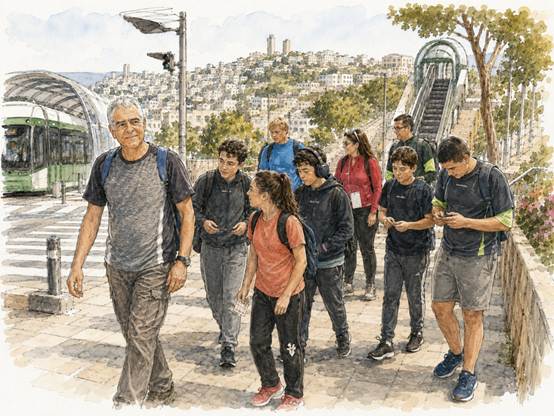
David describes his approach as "assertive, consistent, and embracing." With time and persistence, he has seen the change that occurs in the children. "Today, the children communicate. They have their own WhatsApp group. They go on walks together, take care of each other, reach out and leave no one behind."
David continued, to something that caught my attention even more, "Today I have children who grew up within the framework of the activity. They arrived at the age of 10, 12 or 14, and today they are 27, 28 and even 30. This older group has become the guiding skeleton for the younger group." It's amazing, this is the stage where the project has transformed from a project into a community, when those who were on the receiving end become the guides who give value to the young people.
"The adults lend a hand to the young children. This combination is amazing. An adult child takes responsibility for a young child. He becomes a teacher, guide, and educator for him. This gives the adult meaning and the young person a figure to identify with." This meaning, which David says fills the adults, also fills David himself.
"First of all, do what you love. This is a basic rule in life. I have always loved giving to children, helping them, nurturing them, and empowering them. Over the years, I have learned that there is no such thing as "impossible." Everything is possible, if you insist in the right way."
And he added a sentence that I really connected with, "I don't think you have to be an educator to educate. You have to be a person who believes, gives, and enables. When you enable, things start to flow."
How do you create change?
As people who strive to progress, develop, and succeed, we are sometimes required to acquire new skills and develop new habits. The way David managed to lead the children to independence and the ability to deal with the uncertainty of life is inspiring and can help us both in our personal journey and when we try to build our own group or venture.
I tried to follow David's method for creating change:
Set the target – Before we dive into David's method, it is important to first define the ideal final state we want to reach. "The important value is that after the age of 21 the child will be able to manage on his own: work, get to work by public transportation, manage, and perhaps even live in an apartment as independently as possible, according to his abilities." This is the goal that David defined for himself in working with the children. Not just what activity we will do this week, in the immediate term, but what change we would like to create in the long term.
A clear framework and time frame for the activity – The first and central principle in David's method is the fixed framework, the skeleton of the activity. "The main tip is to maintain straight and clear lines of creative action, without compromises that set back the goal. Many entrepreneurs want to do this, this, and this. In the end, they do nothing. With special children, you can't jump from here to there. You need a fixed and clear skeleton." The fixed and clear framework for action helps us focus our energies toward the goals we have set for ourselves and also helps us persevere. I really connected to this point, I saw it working in "One hour a week", with a fixed framework of activities, without the need for large budgets or large events, just a fixed framework, so that those who come know what to expect at the next meeting.
Ceremonies – A structured activity routine that we do together, in a group setting, allows us to overcome mental barriers that we would have difficulty dealing with independently. "Rituals are very important. Some children face difficulties around eating, using the bathroom, or dressing. When everyone goes together, the child is part of the group and it makes it easier for him. This is how he learns: I need to go to the bathroom to do myself good. I need to eat good food to do myself good. Every detail is connected to another detail." This is the power of the group and the rituals of the group. This explanation by David made me remember an idea that I often return to, one of our important choices is the choice of the environment to which we choose to belong and these are the rituals to which we connect. The environment shapes us in a very significant way.
Courage and perseverance – David does work voluntarily, but he has demands from the parents, courage and perseverance. "Yes. Persistence in the process. That's all I ask. A child on the continuum sometimes tends to withdraw, not connect with other children and stay in his own world. We want to help him change phase, so that he can get along better in our world. For that, the parent has to go with me. Even if the child says "I don't want to", we have to demand that he come and do it," explains David. "It doesn't happen in one day. Some children take more time, and some children less. But it's a job that needs to be done daily. You can't treat it as a class once or twice a week. As far as I'm concerned, it's a school for life."
Recruiting partners and resources
For sailing you need boats and for boats you need money, but where do you get it? How do you find partners in the vision and the journey? For David, one of the main tools is simply to constantly tell what "Champions of life"We do."
David invests a lot of time distributing videos from the activities of "Champions of Life." I discovered an interesting worldview behind the advertising. Advertising has several goals. First of all, to show that the children are capable. "I tell the public: Look these children in the eyes and see that they can," says David.
Another goal is for the children themselves. "Just like you and I have Facebook, the children have it too. I want them to upload pictures, take pictures, feel equal and not be ashamed of themselves." Advertising is a tool for developing their self-confidence.
Beyond that, advertising is a tool for recruiting partners and resources. Every time you move from place to place and need to establish new infrastructure, it requires a lot of money. If you don't advertise and don't inform the public, you won't have the necessary budgets. This point is very important to me for those who want to start the path and establish a social enterprise. Advertising is not something you do at the end when you're done, advertising is your invitation to more people to connect with the enterprise, help and take part.
To be better people
Towards the end, I asked David what he would like people to take away from learning about his activity. "I would like the public not to say, 'This is an amazing activity, but it should be at the neighbors'.' Many times a child is happy and makes noises, and the neighbor tells the family: 'Move, you're disturbing them.' I would like the neighbor to learn to accept this child and understand that he has a right to life, even if he makes noises," says David.
I was very moved by the conversation with David and saw many similarities between his activity and the cleaning activity of "One Hour a Week". The principles are very similar: the skeleton, the rituals, the perseverance and patience on the way to creating change in reality. At the end of the conversation, David concluded, "We need to learn to be better people, with less evil. When you are a good person and when you give, you mainly give to yourself. You wake up in the morning with a tremendous sense of satisfaction and say: Wow, what have I done?"
There are a lot of people in Haifa who already have much more in their hands than they think.
We have experience we have gained at work, relationships we have built over the years, a profession, a hobby, a love for the sea, nature, music, education, sports, languages, the neighborhood or community.
And in our Haifa, there are also people, groups, and places waiting for someone to see them.
The meeting between the two could be the beginning of the next social venture.
Not everyone needs to start a sailing club.
And you don't have to start with a nonprofit, a large budget, or a perfect plan.
Before a child can stand on a stool, sometimes they have to start by wearing a suit.
And even before a project changes a neighborhood or city, it needs to start with one small action that can be repeated consistently.
And that's exactly the idea of "an hour a week," not waiting until we're ready to change the world, but choosing something that's important to us, giving it a permanent place in our lives, and starting with small steps.
To listen to the interview ◄
Baruch Dror – Aeronautical engineer, MBA in Innovation and Entrepreneurship Management from the Technion, entrepreneur and social activist in Haifa. Writes about the people, communities and processes that shape the city, believing that leadership begins with creating spaces where people can take initiative and realize their full potential.
Did the article interest you?