

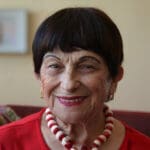
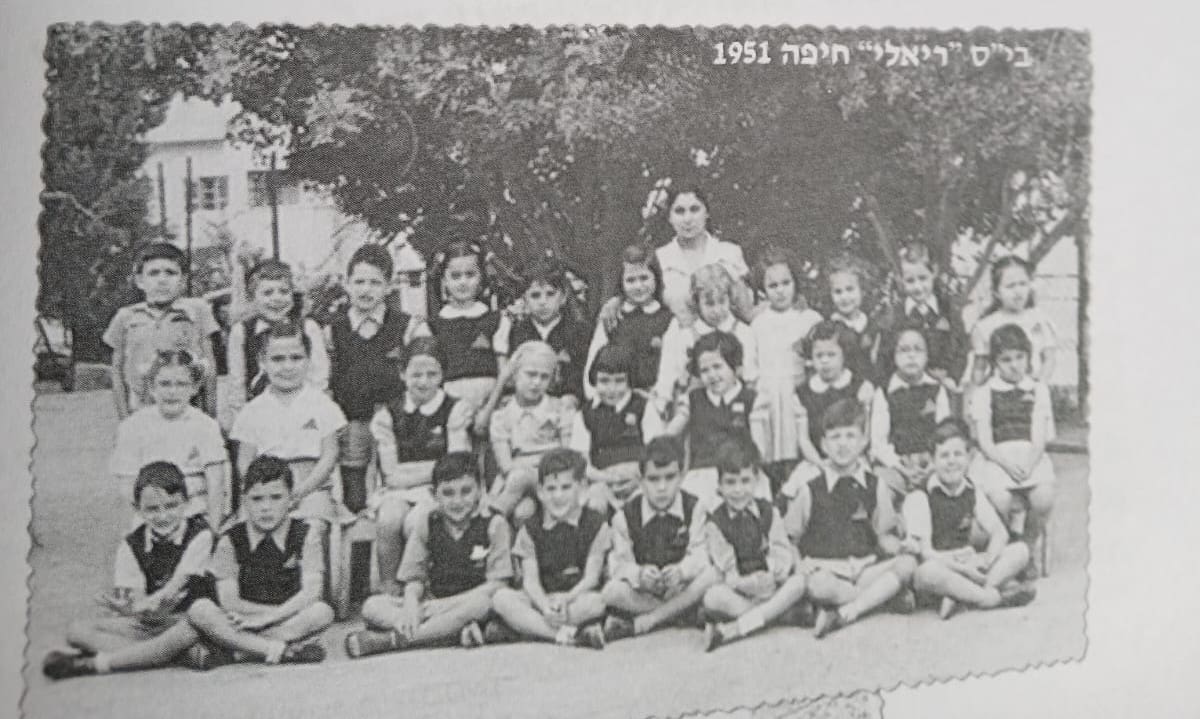
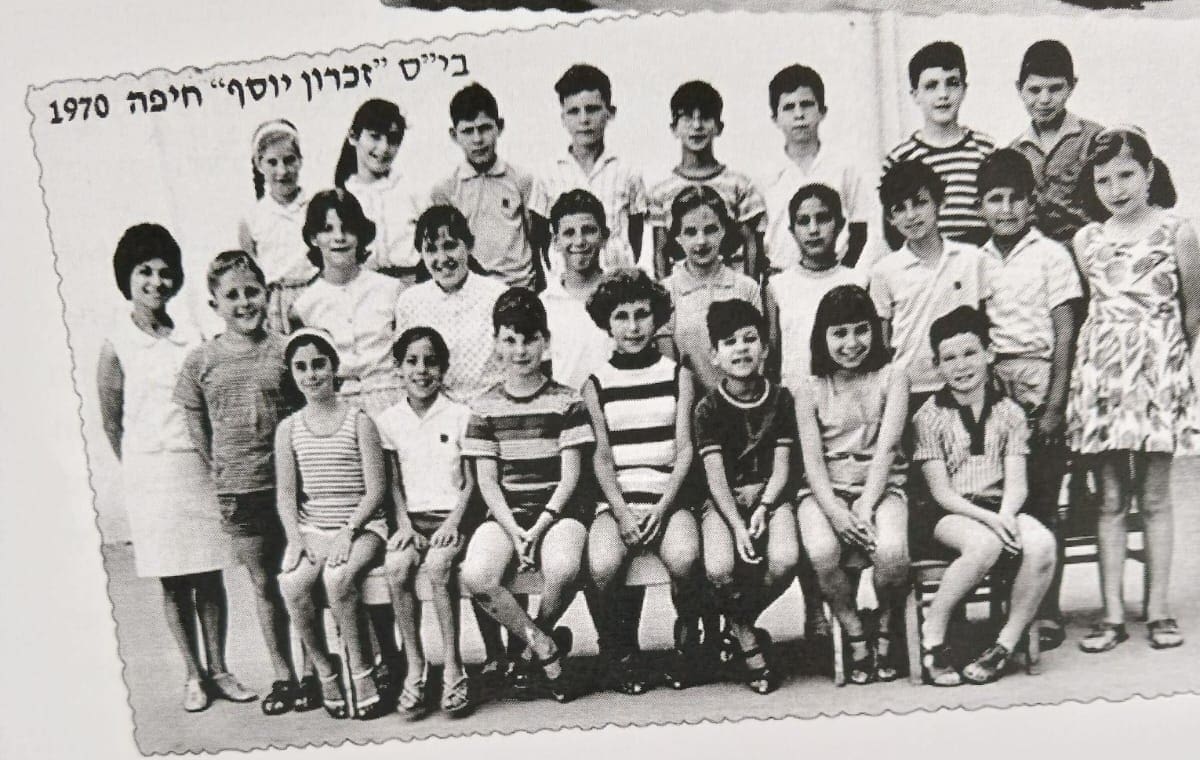
Following David Bar-On's article about the beautiful and ancient buildings of Haifa, the doors of memory opened for me again. Through his words, those streets, those houses, those distant days when I was young, days when time seemed to be shrouded in a cloud of longing, came to mind. Thus I returned to Tiberias Street, to the Yosef Memorial School in the mansion where I taught in 1970, and to the stories that preceded them even further. Out of all of this, one story from 1950 resurfaced, a story about the David Wolfson house and a small first grade class at the Hadar Branch Reali School, some of whose students I still keep in touch with to this day. This is a page from my diary, written with the excitement of someone who finds herself returning home on time.
The article was written in preparation for a meeting my Reali students had about twenty years ago…so I told them how we used to teach…everything is documented…that’s how we used to do it.
Hadar Branch - David Wolfson House
A little history: I worked at the Reali School in Hadar, in the Wolfson House, in 1951, shortly after the War of Independence. Many ask what that building is and who the man whose name is on it is. David Wolfson, a member of a generous Jewish family from England, was born in 1855 and died in 1914. He was an ardent Zionist, one of the spiritual heirs of Benjamin Ze'ev Herzl, and even served as president of the Zionist Organization. Wolfson dedicated his property to many Zionist enterprises, conceived the idea of bringing Herzl's remains to be buried in the country, and was even the one who proposed the Israeli flag in blue and white colors inspired by the tallit. Kibbutz Nir David (Tel Amal) in the Beit She'an Valley, Wolfson Hill on the Carmel, the National Library at the Hebrew University, various buildings at the Reali School branches, including the Wolfson House where I taught, as well as many streets throughout the country, are named after him. Also in the center of the Carmel, near Gan Mania and at the entrance to Kadima Street and the Kabbir neighborhood, there is a street that bears his name.
Wolfson House in Hadar
The Wolfson House is a beautiful stone building that was erected after World War I. At that time, the Hadar neighborhood was not yet as populated as it is today. Among the public buildings were isolated stone houses, including the Technion building, the Reali School building, the former Hadassah Hospital building {opposite the entrance to the Technion}, and the David Wolfson House, which has undergone many changes and additions over the years.
After World War I, when the Reali School was established, Wolfson House was also established. It served as a boarding school for students who came to study from abroad and from distant parts of the country.
I remember that the elementary classes were on Ahad Ha'am Street, and in 1947, when the place became the Reali Teachers' Seminary, {today Gordon College}, the Wolfson House became the Reali Preparatory School.
A central branch, established by Emanuel Yaffe in 1935-6, was established after the basic sects in Hadar. And later in 1938, an Ahuza branch was established.
The special things that were at school back then and have changed slightly
Let's start with the symbol:
A blue triangle with a school logo and the slogan "And modesty is the path"... which is a symbol of simplicity and an expression of the idea on whose knees the school students should be educated.
It was compiled back in 1930, and is taken from the Bible, Micah Chapter 6, Verse 8. {The symbol was prepared by Teacher Sirkin, an art teacher at the time.}
The symbol remains the same, but with a slight difference… Today it is printed on the shirt, tank top or sweatshirt… In the 1950s, it was still printed on a small piece of fabric that was sewn to the shirt or fastened with buttons. And this symbol was transferred from shirt to shirt when washing, for example. The school flag had the same symbol. {The school flag was designed by Dov Midzini, who was a student at the Reali.}
The uniform:
The uniform was modest and simple. It was really uniform… All the students wore the same uniform, the same color and the same pattern, and the emblem was sewn into the garment.
Girls had a light blue dress, boys a khaki shirt and khaki pants. A white shirt was worn only on holidays and for ceremonies. In winter a dark blue sweater. {Boys and girls the same color.}
There was also a khaki hat, with a brim. When the brim was down, it looked like a buffoon hat. When the brim was up, it looked like a sailor's hat.
During recess, it was forbidden to walk around without wearing a hat, and during Bible classes, it was mandatory to wear a hat.
Gym shoes were worn only in gym class. And there was only one model of shoes, the "vulgar" one, I think. A student who wore shoes after gym class was reprimanded.
Today times have changed. – The students, both boys and girls, wear mostly sneakers all day long. Moreover, they come in a variety of brands of sneakers… and also in a variety of brands and colors of jeans, both boys and girls… You see girls with jeans and tights but not with dresses. The colors in the yard are more cheerful and diverse.
It is not mandatory to wear a hat, neither during recess nor in Bible lessons…
But the symbol is still on the garment…not sewn, printed…
By the way: the teachers wore skirts or dresses… not pants.
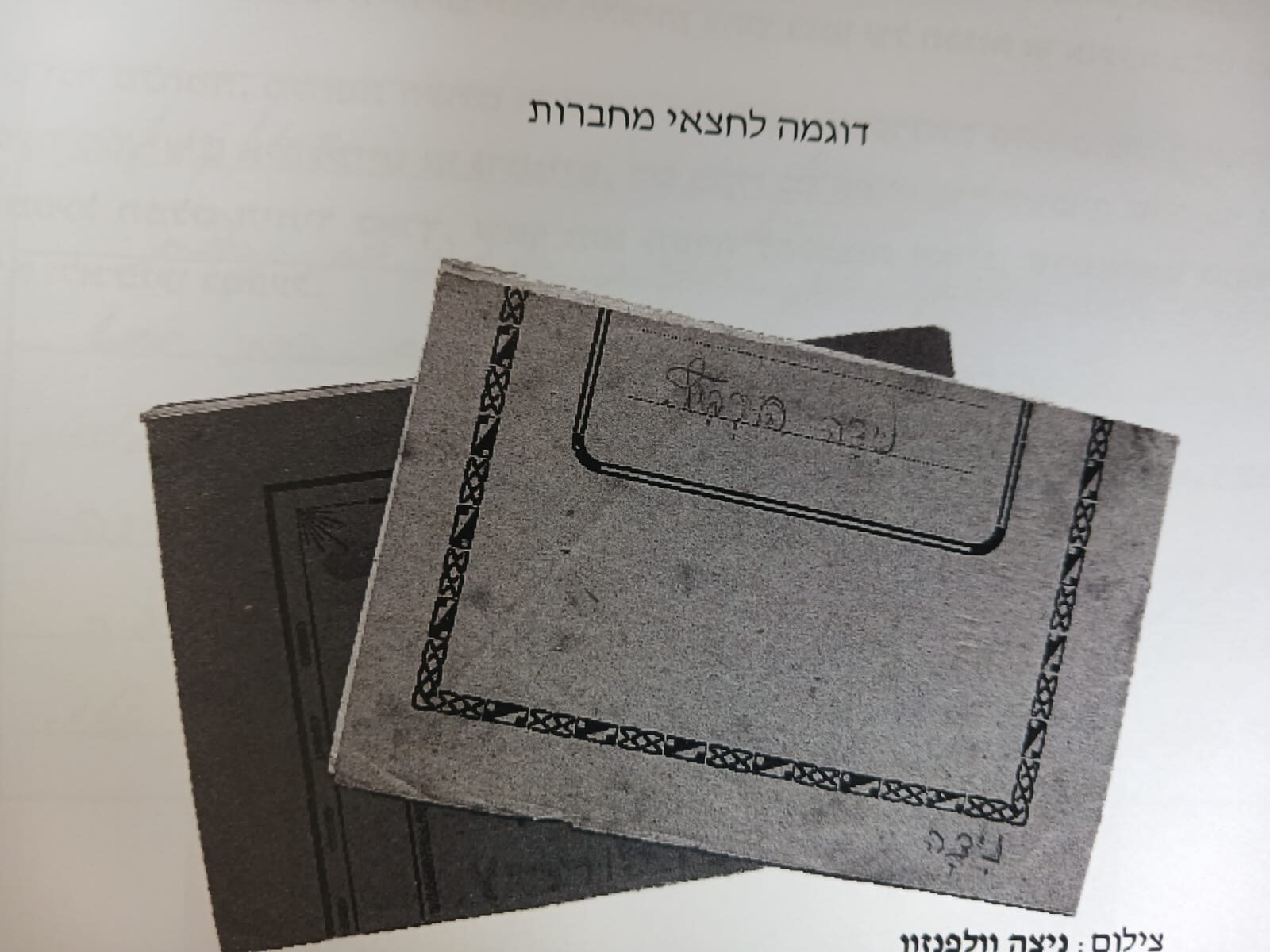
Student equipment:
Like the costume, the student's equipment was also very modest and uniform.
A simple, leather, thin, lightweight satchel, with only two or three compartments. Today you have large, colorful bags, with lots of compartments and zippers. Different and strange decorations. A heavy satchel that is difficult to carry.
The schoolbag of the past contained minimal equipment. In the elementary grades, two or three books, thin notebooks, in a uniform style and with a uniform, simple brown cover. Maybe even a Farber atlas for students in the higher grades.
The students in Mechina A at first had half notebooks to save money. Later on, they received a full notebook. The pencil case was a simple wooden pencil case with only two pencils, an eraser, and colored pencils.
Markers haven't been invented yet...
In the upper grades, they wrote with a fountain pen, the contents of which were filled with ink from a special ink cartridge. In earlier years, before the fountain pen, which was expensive and prestigious, was used, they wrote with a pen with a nib. At each child's desk, there was a recess on one side with a cartridge with ink. They dipped the nib in the ink from the cartridge, wrote, and immediately dried the writing with special absorbent paper so that the page would not get dirty from the excess ink.
One also had to be careful when writing, so that the palm of the writing hand would not get dirty with ink and stain the entire page. It was easier for students who wrote with their left hand.
There were only three colors of ink: black, red, and green.
TodayThe schoolbag is packed with notebooks of various types, the covers are decorated with colorful drawings and advertisements, the selection is large and varied. In addition, the schoolbag is loaded with brochures, books, large pencil cases with plenty of markers, paints, erasers, sharpeners and other various additions...
Each student had a small towel, hanging on a hanger at the side of the table {they washed their hands before eating}. A lunch bag with a napkin embroidered with the student's name and a lunch of ten, a sandwich of bread and fruit only, no gum or candy...
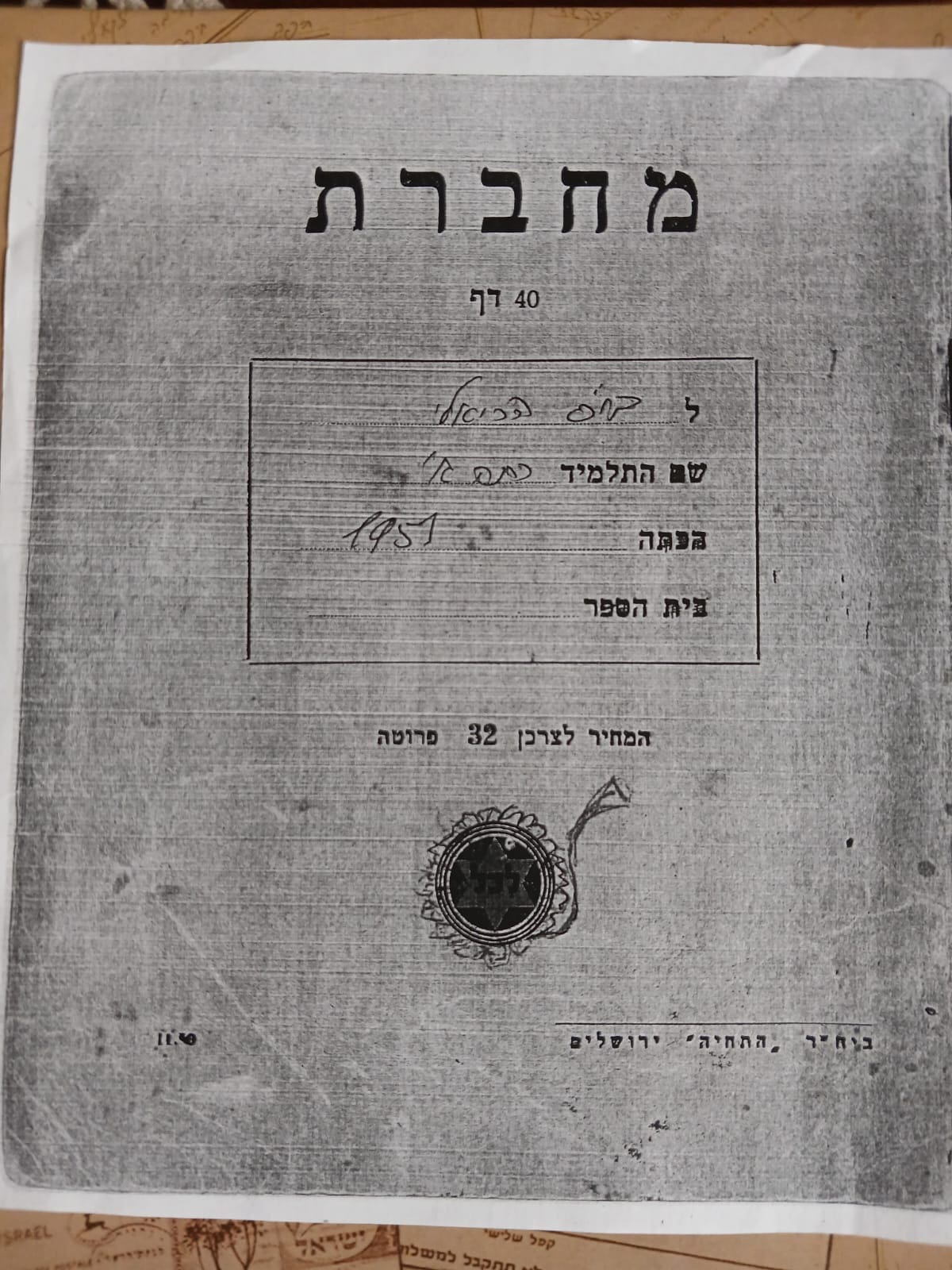
Teacher equipment:
The teacher's equipment was also meager. They received everything in rations, saving on paper for making posters and study cards for illustration. There was a server named Pinchas and a secretary named Yunina, who were very careful with the instructions. There were no films, presentations, computers or other electronic devices for illustration and teaching. There was rations of Bristol paper, simple writing instruments. Watercolors or colored pencils. That's all...
The teachers made all the visual aids themselves. Placards, worksheets, and the like. Sometimes we made them from recycled cardboard or paper that had already been printed on. I even made a magic lantern out of a cardboard box. And also a rag doll for a puppet theater.
The teacher had a large black board, on which they wrote with white chalk and highlighted with colored chalk, words or sentences as needed. The board was cleaned with a damp cloth.
The teacher's desk stood on a small wooden platform {pedestal}. Attached to the desk was a large sharpener, with which the teacher sharpened the children's pencils when needed... and there was also a pointer {small stick} for teaching from the board.
I don't remember the teachers' room, I don't think there was one. During breaks we were in the yard with the students. The principal was Emmanuel Yaffe. A very strict educator, on the other hand, a creative person, who valued creative ideas and even encouraged them. Personally, I was lucky, I loved teaching through songs and puppets and he encouraged me a lot...
"And dare came out sweet"... Later I wrote booklets for teaching reading through poetry and a book for puppet theater {for which I received recommendations from both Emmanuel Yaffe and Mahan Berin}.
School customs in those years… Discipline:
They attached great importance to discipline. They were very strict on this issue and did not compromise. There were notes on order, behavior, and diligence. A student who received five notes was reprimanded, and if he was reprimanded twice, his parents were summoned and he was warned!!! After three reprimands, the student was removed from school. They jokingly called it "flying without wings."
When the bell rang in the morning, all the students lined up in rows, pairs, by class, in the school yard. Each teacher stood by his class. In the yard, everyone sang the song "Adon Olam" together, with teacher and principal Hanan Brin leading the music. When the morning ceremony ended, the students marched in complete silence to class in rows like little soldiers, with their hands clasped behind their backs, so as not to start a fight, God forbid.
Before entering the classroom, the students stood in the hallway close to the classroom wall by the door and listened to the teacher's instructions. "Make a small space in front." Then the students raised their folded hands in front of them and created a small space from each other. Then came the instruction "Hands back, step into the classroom." And they quietly entered the classroom in pairs. The children stood quietly in the classroom behind the chair and sat down only after receiving the instruction to sit.
A student who was late in the morning was not allowed to enter class and had to report to the secretary, Yunina, or to the server, Pinchas.
So, every time, when the bell rang, the children immediately lined up in the yard. In the morning before entering class. After recess and upon leaving class at the end of the school day, the teacher accompanied her students to the school gate. She made sure to maintain straight lines, discipline, and proper behavior.
In class
There were no heaters or air conditioners, it was cold in the winter and hot in the summer, and no one complained.
We sat in rows in exemplary silence. When instructed to "hands forward," they immediately placed both hands on the table, with their fingers intertwined. In the preparatory classes, they sang the song: "Let's see, let's see, let's see, who's sitting nicely?". Then the children would immediately stand up straight, clasp their hands nicely on the table, and listen... In this way, they concentrated only on the lesson, did not play with their hands in anything, and did not disturb their partner at the table.
Most of the classes were frontal.
We were very careful about beautiful writing. We called it "perfect writing" classes. Each student had a special notebook for practicing "perfect writing" {They hadn't yet invented the computer for every child, or the laptop for every teacher.}
There was a beautiful custom at school: Every few days we learned a beautiful proverb, which we memorized from time to time and especially at the appropriate moment... For example: when two children were fighting, we recited in class, "What is hateful to you, do not do to your neighbor" and "Love your neighbor as yourself" and we also sang, "Don't hit, it's not nice, give me a hand, we'll be good friends"...
The school had a nurse who often came into the classroom to check on the cleanliness of the students and the cleanliness of the classroom.
The teacher also checked the students' cleanliness. They would place their palms on the table and the teacher would go between the tables to check, and at the same time they would memorize proverbs: "Thus said the number ones, don't grow nails"... or "I will take a handkerchief with me, it will protect my health"... {Back then there were no tissues. Every child had a handkerchief.} The many proverbs that were learned in an indirect way became a linguistic and cultural asset for the students.
When we accumulated many proverbs, we also held a proverb quiz and competition…
For the tenth meal, the students spread a small napkin on the table, went out in pairs to wash their hands. And wiped themselves with a small towel that each child had. They ate the food in class with the teacher, after reciting the blessing "He who brings forth bread from the earth."... They recited and sang "There is no Messiah during the meal"...
The break:
The breaks were divided into stages according to sects.
There is a separate break for Preparatory School A. There is a separate break for Preparatory School B and C, and there is a separate break for Grades 4-6.
The teachers supervised the students during recess.
They played with rope, with a club, with five stones, with sticks... There was no singing and no dancing, everything was simple and modest...
In the schoolyard there was a large plot that was the school garden, a magnificent garden that the students cultivated starting in the third grade. Fortunately, I loved nature very much and took on the role of the gardening teacher. We grew onions, carrots, radishes, lettuce, cabbage and more in the garden…
Today there is no trace of that garden, everything is covered with asphalt and concrete… terraces were added, various additions were built to the building. And as I said at the beginning of my speech. Over the years, the Wolfson House has taken on and lost form, and that is natural… in accordance with current needs.
syllabus
The curriculum was uniform for all the parallel classes, for every three or four parallel classes, there was a coordinator. Our coordinator in the preparatory classes for the first grades in Hadar was Hava Palemon {she also wrote special booklets for teaching arithmetic}. My fellow parallel class students were: Esther Yalon, Sara Yitzhaki, and Hava Palemon. Later, each of us wrote a book or textbooks.
We always sat together and planned the academic topics and lesson plans we wanted to teach. We were very careful about writing neatly in the class diary and in the notebook of lesson plans we were supposed to give in class. After each topic we studied, we reviewed it with each other to learn and draw lessons. We made sure to read fluently, to understand what was being said, and to write perfectly.
Celebrations and parties:
Each sect layer had joint celebrations and parties.
The sects were not populated and it was both easier to teach and easier to hold joint celebrations.
The Book Festival, the Hanukkah Festival, Purim, Shavuot, etc.
What nostalgia I found myself in the picture of Zichron Yosef. Many of the descriptions of the real life were the norm at that time. Proper education, helping others was the top goal. Great proverbs, even half of my classmates in first grade were modesty and thrift.
Wow, how thin I was 🌸
– An ink cartridge, not a cassette.
I began my studies at Mechina A in 1949 (Hava Palemon is an educator) and I really, really don't miss the Wolfson home. Not the strict rules, not the discipline that was based on fear of punishment (among them those comments you describe as fond memories), and not the achievement that took the place of compassion and inclusion for those who didn't meet expectations.
Although my memories do not inspire nostalgia, I enjoyed reading the pages of your diary, Yehudit. Thank you.
I definitely miss it, we used to read in a book and have discussions in class. ) My children mainly studied in the focus group, and are learning to use AI. I wish they would go back a little to proverbs, and to the oral study of the Song of the Sea, and basic knowledge, in the division, siddur, Rambam and Agada, and so on and so forth.. Comprehensive knowledge, Ahad Ha'am, Buber,... I lack a lot of things today. I hope that I, I want to say, Yashar Ka'ah, !🙏❤
I also studied in Hareli from first grade at the Wolfson House in the division near the Technion and in high school at Beit Biram.
The person who wrote it brought back memories from long ago, just like I experienced myself.
To this day I cherish the education and values we absorbed, my child. Beautiful Janu, back then.. In 51 I was 8 years old in the third grade at the Wolfson house.. We used to be…
I studied there starting in first grade in 1961. Yunina and Pinchas were still there. On the top floor of the building was still the boarding school, including the beds for the students, which two years later was converted into a concert hall.
Did you study with Pinchas?
A rack. Not a chore.
Very moving. Can I have the lyrics to the song "Lord of the World" that we sang? And you didn't even count the tin cup with the cocoa we received. I studied in the first grade in 1950. Sometimes at night in my dreams I smell the cocoa.
The words to "Lord of the World" are found in every prayer book.
Friend, we emptied Judaism from this school.
Hi Yael, we studied together…
I also enjoyed remembering the taste of the past.
Correction: Lord of the world, we sang in class with the original text. We didn't sing the march from the yard to the classroom, but it was the loudspeaker that played a song for a walk and I'm not sure which one: Will we build our country?
All the best