


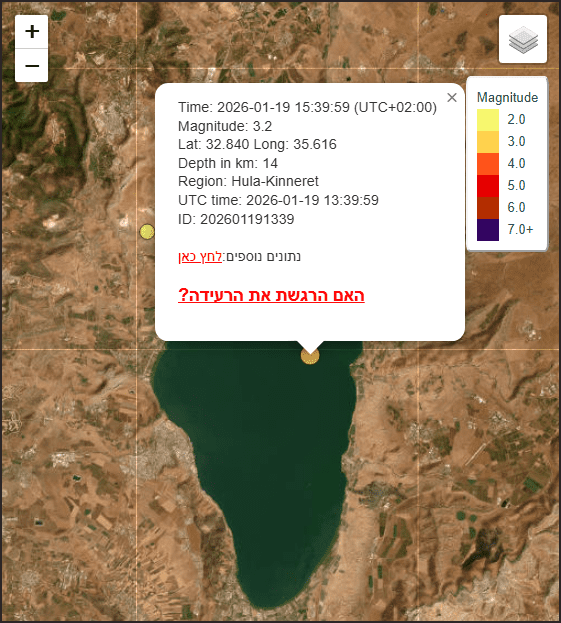
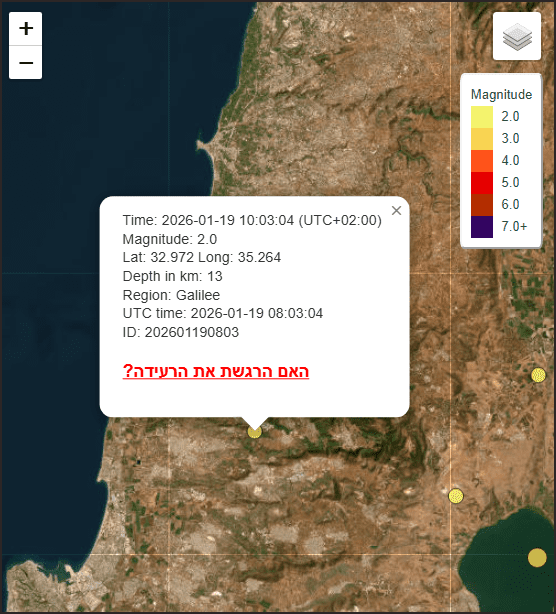
(haipo) – According to data from the Geological Survey, today (Monday, 1/19/26), at 15:39 PM, an earthquake occurred in the Hula and Kinneret areas with a magnitude of 3.2. Also at 10:03 AM, a smaller earthquake with a magnitude of 2.0 occurred in the Galilee area.
Why are there earthquakes at all?
Earthquakes are the result of the movement of tectonic plates and the sudden release of energy along geological faults (faults in the Earth's crust). In the Israeli region, the central story is the Syrian-African fault system (Dead Sea Transform), an active plate boundary along which stress has accumulated over years, and when it is released, an earthquake occurs.
In addition to the intensity of the earthquake itself, the damage is also affected by what is called the “site effect”: soft soil/fill, which may amplify the vibrations relative to hard rock, so even areas far from the fault can experience significant shaking in certain structures.
Risk hotspots in Israel: Where is the chance of a strong earthquake higher?
1) Jordan Valley–Sea of Galilee–Dead Sea–Arava–Eilat
This is the central “axis” of the Syrian-African rift in Israel, and therefore it is considered the main risk center for strong earthquakes.
2) Secondary replica/extension areas
Beyond the main fault, there are active replicas and spurs, which are capable of producing seismic activity and affecting the behavior of the ground in populated areas.
3) Coastal Plain and Haifa/Acre Bays – “Site Impact”
Not necessarily because of proximity to a fault, but because soft sedimentary soils can amplify vibrations. This is one explanation why regional tremors can be felt well even in coastal cities.
How are earthquakes measured – and what does that mean for us?
Earthquakes are currently measured using Magnitude scale (Mw), a logarithmic scientific scale that describes the amount of energy released at the epicenter of an earthquake. Unlike the old Richter scale, the magnitude scale allows for precise measurement of even extremely strong tremors. Each increase in magnitude on the scale means a tremor that is ten times stronger in vibration and about 32 times stronger in energy.
In addition to the magnitude, researchers also usePower scale (such as the Mercalli scale), which describes the actual impact of the earthquake: the feeling of shaking, damage to buildings, and impact on daily life. The intensity of the earthquake varies from place to place and depends on the distance from the epicenter, the depth of the earthquake, and the type of soil.
The measurement is carried out using Seismographs, sensitive devices that detect tiny vibrations in the ground. Israel has a dense network of seismic stations, which makes it possible to identify tremors within seconds, determine their location and strength, and even activate early warning systems.
Earthquake scale – what do you really feel?
- Up to Mw 2.0 – Not noticeable at all
- Mw 2.0–3.0 – A slight feeling in a few
- Mw 3.0–4.0 – Perceptible shaking, hanging objects moving
- Mw 4.0–5.0 – Strong shaking, minor damage to weak structures
- Mw 5.0–6.0 – Actual damage: cracks, falling objects
- Mw 6.0–7.0 – Heavy damage, local collapses
- Mw 7.0+ – Destructive earthquake, danger to human life
The same earthquake can cause different damage in different areas, depending on the soil and the quality of construction.
“What happened recently?” A brief survey of tremors felt in Israel
- January 15th 2026 – A tremor was felt, with a reported intensity around M~3.9 (with in-depth reports), and also led to public discourse around the warning system.
- November 12 2025 – Strong tremor M~5.1 In the Cyprus region, which was reported to be Felt in northern Israel.
- May 22 2025 – Strong earthquake in the Crete area (reported around M~6.1), which was reported to be It was also felt in Israel..
A guide to “Do’s and Don’ts” during an earthquake
Made
- If you can get outside within a few seconds, go to an open area.
- If you can't leave immediately, go to the emergency room. (And in the absence of a deputy: To the stairwell).
- Stay away from windows, shelves, and objects that could fall.
- After the earthquake ends: Try to carefully go out into an open area, stay away from damaged buildings and downed power lines, and be prepared for aftershocks.
Do not do
- Do not use the elevator.
- Do not run up the stairs while shaking. (High risk of falling).
- Don't light a fire. If there is a suspicion of a gas leak/infrastructure damage.
- Do not enter damaged buildings. Before appropriate inspection/approval, and avoid approaching structures with visible damage.
Earthquakes are when the Earth grows. And when there is an explosion in a volcano, it is when the heart of the Earth is suddenly closed and opened like a catheter.
Very informative. Thank you very much for the knowledge. I have learned.
It's a shame that the issue doesn't interest the Israeli government, so the results will be devastating.
Uncle, as far as I know, you are an expert in dogs and locating missing persons, not earthquakes.
There are quite a few greedy TAMA 38 developers who spread and create unnecessary panic as self-proclaimed "experts" in the field of earthquakes, especially after a moderate earthquake in Turkey or Japan.
In a city where destructive development plans are approved, often without any proven justification and based on false infrastructure created by the Municipal Engineering Administration and the leadership of the local Planning and Building Committee, it is appropriate that you step down from a subject that you are undoubtedly knowledgeable about.
The faithful reader is mistaken and misleading.
Experts have already said that when there is a strong earthquake, many old buildings will collapse and there will be thousands of deaths.
The question is not if it will happen, but when.
Israel has a strong earthquake every 100 years, and almost 100 years have passed since the previous strong earthquake.