


(Hai Fa – Haifa and the surrounding area news corporation) On the occasion of International Children's Day, the Central Bureau of Statistics publishes a collection of data on the child population in Israel for 2026. The data indicate that Haifa is below the national average in the proportion of children in the population, and also in the average number of children per family. Alongside the demographic data, the report presents a broad picture of education, welfare, child safety and social disparities.
Only 22.6% of Haifa residents are children
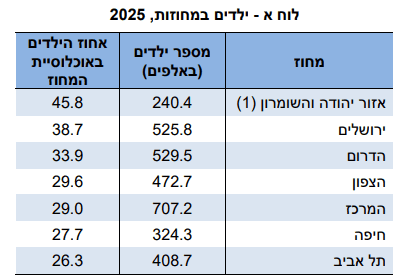
One of the most striking figures regarding Haifa is the proportion of children in the city's population. According to CBS data for 2025, children up to the age of 17 make up 22.6% of Haifa's population, compared to an average of 29.7% in major cities in Israel.
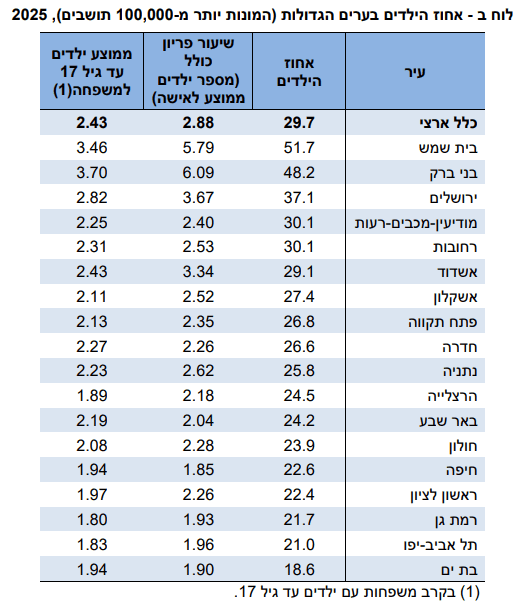
This figure places Haifa among the large cities with a relatively low proportion of children. For comparison, in Bat Yam the proportion of children is 18.6%, in Tel Aviv-Yafo 21%, and in Ramat Gan 21.7%. On the other hand, in Beit Shemesh children constitute 51.7% of the population, in Bnei Brak 48.2% and in Jerusalem 37.1%.
Even compared to the districts, the proportion of children in the Haifa District is relatively low. In the Haifa District, children constitute 27.7% of the population, compared to 29.6% in the Northern District, 29% in the Central District, and 38.7% in the Jerusalem District.
Less than two children on average per family
Another statistic that illustrates Haifa's demographic characteristics concerns the number of children in a family. According to the Central Bureau of Statistics, in Haifa families with children up to the age of 17, the average is 1.94 children per family.
This is lower than the national average, which is 2.43 children per family. Here too, Haifa is at the bottom of the ranking of large cities. Ramat Gan and Tel Aviv-Yafo recorded even lower averages, 1.80 and 1.83 children per family, respectively.
The total fertility rate in Haifa is 1.85 children per woman, compared to the national average of 2.88. For comparison, the fertility rate in Beit Shemesh is 5.79 and in Bnei Brak is 6.09.
The data presents a demographic picture in which the proportion of children in Haifa's population is lower than average, as is the average number of children in a family.
Single-parent families and children living with one parent
Nationally, about 91% of children live with both parents. About 270 children, or about 9% of all children, live with only one parent. Most children in single-parent families, about 82%, live with their mother.
CBS data also shows that in 2025, there were approximately 1.26 million families in Israel with at least one child up to the age of 17, including approximately 3.05 million children.
Hundreds of thousands of children in the welfare system
The national situation in the field of welfare also indicates the extent of the needs of children in Israel. In 2025, approximately 490.5 thousand children were registered with the Ministry of Welfare and Social Security. Approximately 139 thousand children were placed in welfare frameworks during the year.
In addition, approximately 229 children up to the age of 17 were included in the registry of people with disabilities.
It is important to emphasize that these data refer to all of Israel and do not present a specific segmentation for Haifa.
More than 357 thousand students with special needs
In the field of education, in the 2024/25 school year, 357,664 students with special needs studied in the Israeli education system. Of these, 61,820 children were in pre-primary education, 178,016 in primary education, and 117,828 in secondary education.
That year, the eligibility rate for a matriculation certificate among those taking the exams was 82.4%. The dropout rate in grades 7 to 12 was 2.1%.
Children injured in road accidents
Road safety data presents another worrying picture. In 2025, 1,431 children aged 0 to 14 were injured in road accidents in Israel. 35 children were killed, 244 were seriously injured, and 1,152 were slightly injured.
The number of children killed in road accidents in 2025 was 20.5% lower than in 2024, when 44 children were killed. However, compared to the average for the years 2021–2023, when 30 children were killed per year, this is actually an increase of 15.4%.
The data emphasizes the importance of road safety and the need to protect children in public spaces, on the way to school, in residential neighborhoods, and around the home.
Haifa's challenge: An aging population alongside a low child rate
The CBS data for International Children's Day presents Haifa with a clear demographic picture: the rate of children in the city is lower than the national average, the average number of children per family is relatively low, and the fertility rate is also low.
This data has significance in all matters relating to long-term urban planning, including the preparation of the education system, planning services for young families, establishing early childhood frameworks, and adapting public spaces for children and families.
With this behavior, it's no wonder that Haifa is a city of old people, minorities, and disgruntled people.
It's a shame that the elderly residents of Haifa are choosing an old man who has smuggled 40 young people out of Haifa since 2003. For 20 years, he has been mainly involved in the serial smuggling of the next generation out of Haifa. Tens of thousands, most of them young people, whose parents have left Haifa. About half of them live in the Sharon and Tel Aviv areas.
Again, the figure is repeated: 40 residents that Haifa has lost since 2003, the beginning of the current mayor's term.
Demographically, Haifa should have had 330 residents today, the forecast given in the early 2000s for the 2020 estimate. The mayor, with stunning success, managed to reduce the number by 40. Other cities such as Rishon LeZion, Petah Tikva, and Netanya grew by 80-100 residents during the same period.
Should we name the child after him?
Demographic collapse in the Jewish sector compared to other sectors.
Families fleeing Haifa due to takeover of the villages.
The loss of the Zionist state with an anti-Zionist majority in the birth data within a decade.
Eliminating the IDF and the Knesset in demographic warfare by failing to mobilize the sectors that hate the state.
Cities that have a high percentage of children are ultra-Orthodox cities. The percentage of children in Haifa is higher than a normal Western city. We don't want to become Beit Shemesh.
Even the Arabs in Haifa, Christians and Muslims, are mostly good families who pay money and send their children to private education.
I wish Haifa would stay the way it is.
🤩😇"Less than 2 children per family"! = 1.5?
Or "Charlie and a Half"…???😘
In short and to the point, it is desirable for the future of "humanity" in general & "Judaism" in particular: "Encouraging fertility" as the important commandment in our Torah: "Be fruitful and multiply and fill the earth"!!!😂
And 🤩 Our beloved "beautiful Haifa" needs to rethink its path, not the increase in "non-Israelites" in our city, because perhaps that is why it is "abandoned" in part... And although the "quality of life" in Haifa can be experienced as excellent in our eyes, it still teaches us that if new young people are not visiting the city; apparently, we need to take care of "cheap housing" & "employment"! ♻️
* We are not interested in the comparison with Tel Aviv in any field… and it is better for “Haifa” to encourage high-quality “educated” people of all ages and professions to choose “life in Haifa”…!!! 😭
Have you heard of an average? It is recommended to complete core studies. Good luck.
Haifa Municipality invests in holiday festivals
Young families are moving to cities that invest in quality of life, cleanliness, and culture.
It's very simple.
What reason is there to live in Haifa?
Top 3 property taxes in Israel
Quality of life at the bottom of the scale.