



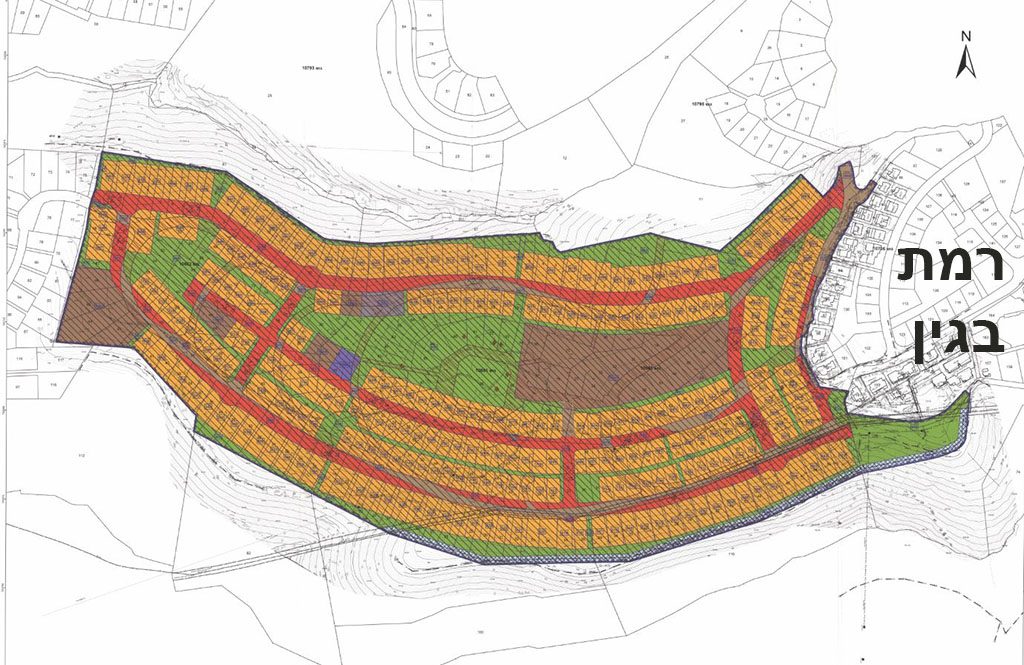
(haipo) The National Planning and Building Council's Appeals Subcommittee published its decision on Sunday, July 5, 2026, in five appeals filed against the Haifa District Committee's decision to approve the Ramat Gural plan. This is one of the largest construction plans in the city, covering an area of approximately 430 dunams on the slopes of Mount Carmel, near the Ramat Golda neighborhood. The plan includes the establishment of a residential neighborhood with approximately 2,000 housing units. The land has been designated for residential use since the mandatory plans of the 30s, but the completion of the planning process was delayed for decades due to objections, legal proceedings, and environmental disputes.

The Appeals: The Plan's Limits and Transportation Phases
The appeals that were filed dealt with two main issues. The first concerned the request of some of the appellants to expand the boundaries of the plan to include private land located on the slopes of the nearby wadis. They claimed that the plan relies on these areas for the passage of infrastructure and access roads, and therefore it was appropriate to include them in the scope of the plan. They also claimed that the exclusion of the lands infringed on their property rights.
The Appeals Subcommittee rejected the claims and determined that there was no reason to interfere with the District Committee's decision not to include these areas in the plan's scope. In its decision, the committee noted that Haifa's planning policy over the years is based on a clear distinction between development areas and the wadis and open spaces, which constitute a unique landscape feature of the city, and that the plan maintains this principle. It was further determined that the plan does not expand the previously determined development areas and even reduces the construction boundaries towards the wadis, and therefore there is no planning justification for annexing the lands simply because some of the infrastructure will pass through them.
The second issue dealt with the transportation phasing mechanism established in the plan. The appellants claimed that the provision limiting the implementation of the plan to a first phase of up to 30% of the housing units, until an additional transportation connection to the west of the city is established, violates their rights and creates uncertainty regarding the date of land realization. The Appeals Subcommittee partially accepted the appeals on this issue and determined that the principle of transportation phasing should be retained, but the implementation mechanism should be changed so that up to 50% of the housing units can be realized instead of 30%. This is a significant achievement for the landowners, who hope that the decision will enable development to begin in the area.
Landowners: “Third generation waiting to see construction”
Ilan Tamir, one of the landowners in Giva, told "Hai Fa": "After a long period, actually a plan from 1935, we have finally reached the most important moment, where the Haifa Municipality is going. There is no way to avoid it anymore, the last appeals are definitely over. We expect the municipality to budget for the development of the neighborhood, including the removal of the fuel and electricity lines. As I understand it, the municipality is trying to recruit an external party to finance the development, and after settling accounts with the owners of the plots, the money will be returned to the financing party. The amount of the improvement levy is not yet known, and this is a problematic issue since there was no change in designation and in fact there should not be a significant levy. I am already the third generation to inherit the plot, and I hope that we will be able to see the fruits of my grandfather's purchase in our lifetime."
Continuing frustration: “The municipality is not making progress, time is passing”
Despite the decision, the landowners express deep frustration. They claim that environmental activists and the municipality are delaying the progress of construction on their land. They are angry that there are no clear timetables, and that in the meantime, city residents are walking on their private land. The fact that they have owned the land for many years, and despite the fact that it is an approved plan, there is no progress, creates a situation of land commercialization, people who lose trust or need money offer the land for sale, and a market of buying and selling is created, as in other neighborhoods where landowners wait many years for construction.
The conflict: between economic profit and nature conservation
The landowners in Ramat Gural are in an ongoing conflict. On the one hand, they own land as part of an approved plan, and on the other hand, they fail to understand why there are no development schedules. Even after the appeals were rejected, they understand that real progress is still far away. Developing the area is very expensive due to the slope, and therefore the Haifa Municipality has no clear economic interest in promoting construction; the revenues from the neighborhood are not expected to cover the development costs. This means that the landowners fear that the Municipality will not do this voluntarily, but only if it is obligated to do so. Some are even considering filing a lawsuit so that the court will compensate them for the losses caused by the delay. Others are angry that their private land has become a backyard for residents, and emphasize that even if there is no construction on it, it is still their property.

Environmental activists: “Goat Hill should be preserved as a natural park”
On the other hand, environmental activists claim that the development in Ramat Gural is a serious violation of Haifa's natural values. Tali Moav, environmental activist, says: “Damaging the western slopes of the Carmel as is being promoted today, without prioritizing and building on the fertilized areas, is a cry for generations. There is an abundance of vegetation in Givat Ha-Izim, much more than in another neighborhood that is also being fought over, Lincoln Slopes. Givat Ha-Izim should be preserved as a natural park as long as the fertilized areas in the city have not been treated with new construction. The problem is the landowners who want to realize their properties, but it cannot be at the expense of the city residents’ ability to enjoy a little green in their eyes.”
Haifa and the struggles for green lungs
The struggle over Ramat Gural is not new to the city. Almost every neighborhood built in Haifa has been accompanied by disputes over nature conservation. The Givat Oranim neighborhood was once the playground of Romema children, and the residents of Ahuza fought over the grove that became Givat Zemer. The city was built on struggles between concrete and greenery, and eventually construction progressed and the struggles were forgotten. But in recent years, with increasing environmental awareness, opposition has been renewed, especially when it comes to neighborhoods on the mountainside, where trees have to be cut down and the landscape damaged in favor of a limited number of housing units.
The question of balance: development or compensation?
The current situation raises a fundamental question that has been haunting Haifa for decades: Is it right to develop new neighborhoods at the expense of green spaces, or should compensation and rights transfer mechanisms be promoted that will allow landowners to receive compensation without harming the landscape and the quality of life of the residents? On the one hand, the landowners own private properties that were promised to them during the Mandate period, and for them, this is a basic right to exercise the land and enjoy its fruits. On the other hand, many residents and environmental activists claim that any further damage to the Carmel slopes is irreversible, and that the city must preserve its green lungs to ensure a quality of life for future generations.
This debate is not just planning, it is also emotional, economic, and social. The landowners feel that the municipality and the state are shirking their responsibility and that they are left with land that does not yield anything even though it is an approved plan. Environmental activists feel that every dunam that is occupied in favor of concrete is a loss of a valuable public asset. The municipality, for its part, is required to balance conflicting interests, but in practice it avoids making clear decisions, which deepens the feeling of implosion. Another point is that in practice, if you examine how much each piece of land was sold for decades ago, you discover that it was a limited financial investment, apparently, which is why today the heirs are demanding to take a green lung and turn it into a public housing estate.
Environmental activists: “It is impossible for private interest to prevail over public interest”
Environmental activists, on the other hand, argue that the landowners cannot demand development at any cost. They argue that Givat Ha'Izim is one of the city's remaining important green spaces and that turning it into a residential neighborhood would severely damage the Carmel landscape. They point out that Haifa has already lost many green spaces to construction, and that urban renewal should first be promoted in the degraded areas before touching the mountain slopes.
Tali Moav explains that “the problem is not only the construction itself, but also the long-term consequences. Once you start developing the slopes, there is no turning back. It changes the entire ecosystem of the area.” According to her, the municipality needs to lead a clear policy that favors conservation over development, especially in sensitive areas like Givat Ha’izim.
Haifa between past and future: recurring struggles
The debate surrounding Ramat Gural is reminiscent of previous struggles in the city. Almost every new neighborhood in Haifa was born out of opposition, Givat Oranim, Givat Zemer, Ramat Hanasi, Ramat Almogi. Each time, the residents fought for the grove, for the view, for the quiet. And each time, in the end, the construction progressed and the struggle was forgotten. But in recent years, with a rise in environmental awareness and the realization that the city's green spaces are limited, the opposition has become more significant.
The municipality, for its part, is required to decide between the need to increase housing supply and the desire to preserve natural values. But sometimes it seems that it prefers to wait, hoping that time will resolve the dispute. In practice, waiting only deepens the gaps between landowners and the public.
The decision: You can start promoting — but there is no beginning
The appeals committee's decision stated that there was no impediment to starting to promote the plan, but the landowners immediately understood that this was only a planning advance, not a practical one. There are no timetables, no budget for development, no start. The decision allows the neighborhood to be promoted, but does not obligate the municipality to actually carry out the development.
The landowners were happy for a moment, but after reading the decision, they realized that the real struggle was just beginning. They expect the municipality to present a clear development plan, budget, timetables and a mechanism that will finally allow them to realize the land. In the meantime, they feel that the municipality is preventing other parties from taking responsibility, but is also not offering a solution.
The municipality's response:
The Haifa Municipality has provided an official response to the appeals committee's decision: The plan was approved in 2021, during the previous city administration. The Haifa Municipality will study the National Council's decision and its implications, and accordingly will formulate its position and further action on the issue. At this stage, it is too early to address timetables, planning aspects, or development costs, and these will be examined after studying the decision.
Did the article interest you?
The new plan was designed by a pretender to be an architect. It contains many planning errors, for example the central street, which runs through a quarry for dozens of meters on both sides.
I wonder how the Haifa Municipality will do this?
Givat Ha'Izim is simply a huge failure by the Haifa Municipality. The 2000 housing units should have been included in the land exchange in Neot Peres and Neot Navon. All it is about is approving several high-rise towers that would have provided equivalent value in the landscape and within the existing urban continuity.
Simply the destruction of the last continuous natural area on a hill on the western slopes.
Of course, the value of real estate in Ramat Golda will plummet following its transformation into a traffic route to Ramat Gural and the development burden and concealment of the landscape that Ramat Gural will cause on Golda. The addition of a traffic route to Carmel at the expense of Ramat Golda and thousands more cars in the neighborhood, which is obviously being built in a way that cannot be served by public transportation, is another campaign to destroy the quality of life in Haifa by the Planning Department in the Haifa Municipality.
Givat Ha'izim is a Haifa gem and should remain a green lung.