


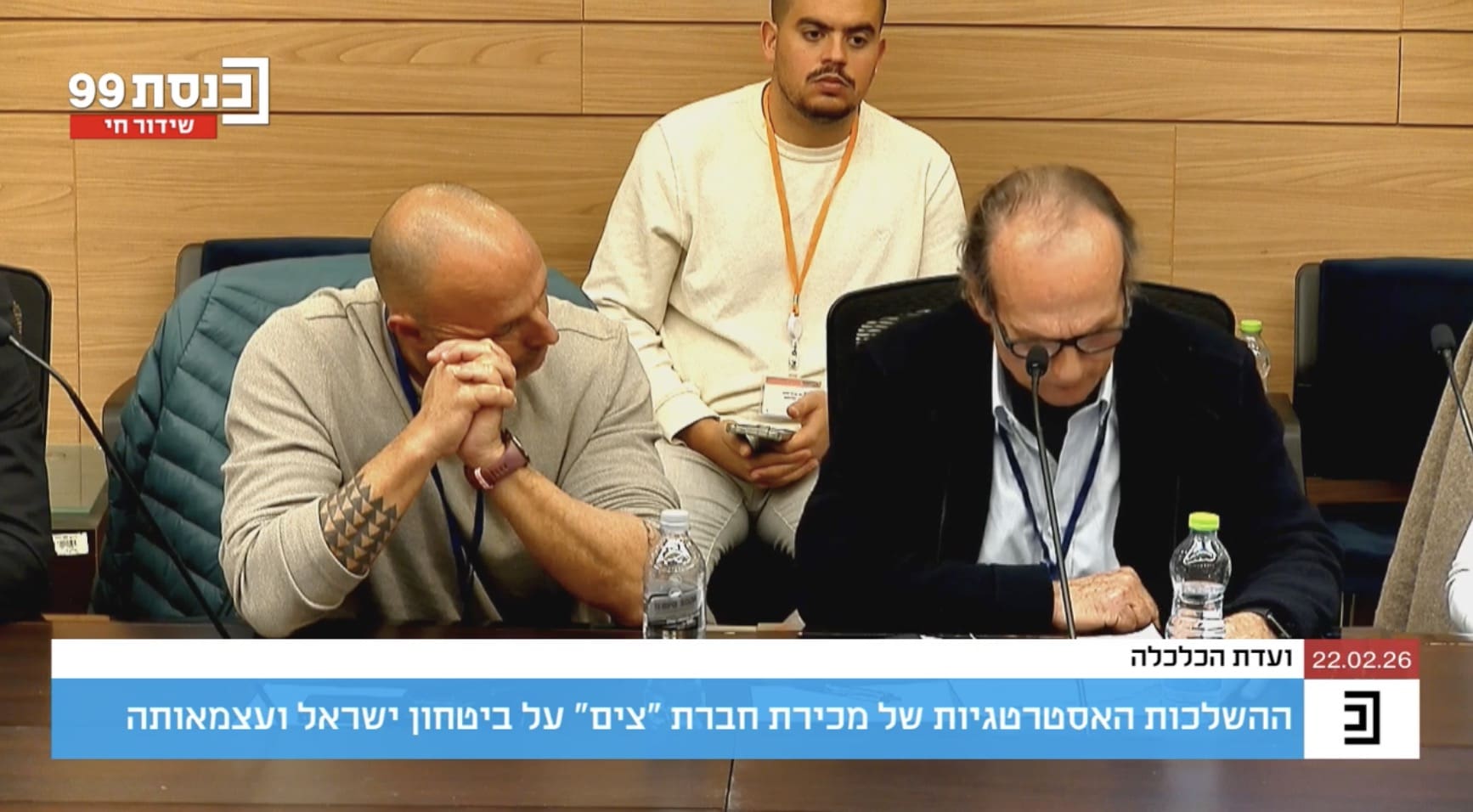
(haipo) – The deal to liquidate the shipping company Zim, split it up and sell it On Sunday morning, 2/22/26, a critical debate was held in the Israeli Knesset's Economic Affairs Committee, chaired by MK David Bitan (Likud). The debate was initiated by MK Oded Forer (Yisrael Beiteinu).
Watch the full broadcast of the debate in the Knesset's Economics Committee
To watch the discussion on YouTube, including English translation – link…
Based on the positions expressed in the debate, it can be concluded that a large number of Knesset members, as well as managers in government ministries, are now joining forces to stop the move and have even expressed implicit and direct resentment over this move, which was launched without direct state involvement and without a "pre-rolling" process, i.e. a preliminary process in which the state's position is examined in advance before contracts are executed with a potential buyer (the shipping company Hapag-Lloyd).
Against the backdrop of ongoing war, geopolitical challenges, and economic pressures, the question is now becoming more acute as to how the State of Israel balances essential security needs with the principles of the free market and public ownership of the ZIM shipping company, and whether such a deal can even be carried out without harming the long-term strategic interests of the State of Israel.
Here are a number of points raised during the summary phase of the committee discussion, by the Knesset members who led the discussion:
(We will later attach here, for your reference, additional points that came up in the discussion in the Knesset Economics Committee, as well as the recording of the entire discussion – when the recording will be posted on the Knesset website)
The general background to the discussion surrounding the sale of ZIM
The discussion surrounding the sale of the shipping company ZIM is not taking place in a vacuum, but against the backdrop of a complex security reality and changes in the global shipping market. ZIM, as the largest and most central Israeli shipping company, has for years been an important component of Israel's ability to maintain maritime transport continuity, especially in times of crisis. The possibility of selling control or a significant part of the company raises weighty questions regarding the state's ability to influence its activities in times of emergency, and regarding the legal and regulatory mechanisms at its disposal.
Ministry of Defense Position: Zim's Contribution During the War
The Defense Ministry has presented a clear position that the Israeli shipping company ZIM played a critical role during the last war. According to sources in the defense establishment, the company provided a vital logistical response at almost every point where it was needed, precisely when other international shipping companies refused to transport security equipment to Israel. These refusals, which stemmed, among other things, from an unofficial embargo or from fears of harm by pro-Palestinian activists in their activities in European ports, have sharpened Israel's dependence on independent maritime transport capabilities.
The international embargo and its practical meaning
The security system describes a growing trend of hardening positions on the part of European elements and international companies, who are not prepared to dock at ports with cargo destined for Israel. This situation creates a strategic bottleneck and emphasizes the importance of maintaining control and influence over the activities of the shipping company ZIM. From the perspective of the Ministry of Defense, a future deal that does not guarantee the country the ability to realize its security needs could harm the ability to bring essential equipment in real time.
Functional continuity and long-term thinking
Security officials emphasize that the modern concept of security requires preparation for long wars that do not end in short periods of time. Accordingly, the functional continuity of the maritime transport system is not a one-time issue but an ongoing strategic need. In their view, the state must maintain security and vital interests even if this requires strict restrictions or conditions on capital market transactions.
The gold stock as a decisive factor in the Companies Authority's position
Government Companies Authority Focused on discussing the status of the gold share and the powers derived from it. According to the Authority, The state has clear authority to approve or disapprove a transaction., and to set conditions for such approval. The mere fact that parties interested in acquiring control of the shipping company ZIM have already declared that the company does not meet the conditions of the golden share, constitutes, in the opinion of the Authority, a worrying indication that must be taken into account.
Control, influence and defining ownership boundaries
The Companies Authority clarified that control is not measured solely by holding the majority of shares. In a company with a dispersed ownership structure, even holding about 10% can confer the ability to direct the corporation's activities. In such cases, Explicit, prior, written approval is required from the holder of the special state share.This position is intended to prevent a situation in which de facto control would pass to private or foreign hands without oversight by the State of Israel.
The issue of fragmentation and its regulatory implications
It was further clarified in the discussion by representatives of the Companies Authority (the regulator on behalf of the State of Israel) that Any split or structural change in the shipping company ZIM requires the unequivocal approval of the state share – the holder of the golden shareThe meaning, they say, is that even moves that are not a direct sale of control, but may affect the way decisions are made in the company, fall under the umbrella of the gold stock and require in-depth examination and regulatory approval.
Remarks by the Chairman of the Economic Committee: The need for in-depth examination
The chairman of the Economic Affairs Committee, David Bitan, concluded the discussion by stating that this is a sensitive issue that requires continued careful handling. He said that a follow-up discussion will be held and a confidential meeting will be scheduled immediately to be dedicated to the security aspects related to the Israeli shipping company ZIM and the initiative to sell it. David Bitan emphasized the need for a formal, orderly request for information from the management of the shipping company ZIM and a preliminary examination process with the potential buyers, with an emphasis on the FIMI fund.
Demand for clarifications and collateral from buyers
Bitan called for an early dialogue with the FIMI fund, in order to ensure that it indeed intends to meet the conditions and strategic needs of the State of Israel. He asked to know what collateral the buyers are willing to provide, and whether meeting the conditions of the gold share requires the state to approve the deal. These questions, he said, must be answered clearly before a decision is made.
Possibility of direct state involvement in the acquisition of ZIM
One of the proposals that has been raised is examining the possibility of the state itself acquiring part of the company, perhaps even in partnership with the FIMI fund. David Bitan noted that it is not necessary for the state to own 100% of the shares, but such involvement may allow for better protection of the strategic interests of the State of Israel, especially given the existing restrictions on the realization of the gold share when the company is traded on the American stock exchange.
Criticism from MK Oded Forer: Concerns about violation of gold share conditions
MK Oded Forer raised sharp criticism, according to which it was revealed during the discussion that the shipping company ZIM itself did not meet the conditions of the golden share over the years. In his view, this is a disturbing event, with significant future implications, with an emphasis on security and logistical implications, concerning the stability of supply lines to the State of Israel. Forer emphasized that the purpose of the discussion is not to deal with employee agreements, but to ensure continuity of maritime transport for the State of Israel even in times of war.
The need for a clear legal definition
MK Oded Forer demanded that the Legal Advisor of the Economy Committee present to the Knesset members a clear definition of the golden share and its practical meaning. According to him, it must be clarified whether holding 20% or 23% of the shares constitutes control, and what legal tools are available to the state in such a situation. Only such clarification will allow for an informed discussion and ensure that national interests are not harmed.
The tension between economics and security in the decision on the future of ZIM
The discussion surrounding the sale of the shipping company Zim illustrates the constant tension between free market economic principles and national security needs. On the one hand, there is a desire to enable business flexibility, foreign investment, and the realization of economic value. On the other, there is a broad understanding that in the shipping sector, and especially in the current security reality, the state cannot afford to lose control and influence over a key strategic asset.
Did the article interest you?
The matter should be discussed behind closed doors. This is about state security. There is no doubt that when they receive a report on ZIM activity since the establishment of the state to the present day, what will be the decision?
Without specific reasons and without real, documented concrete examples, it is not possible to make the right decision...
Everyone understands the magnitude of the problem, but do they have enough will to do the right thing and stop the deal??? Politicians…