


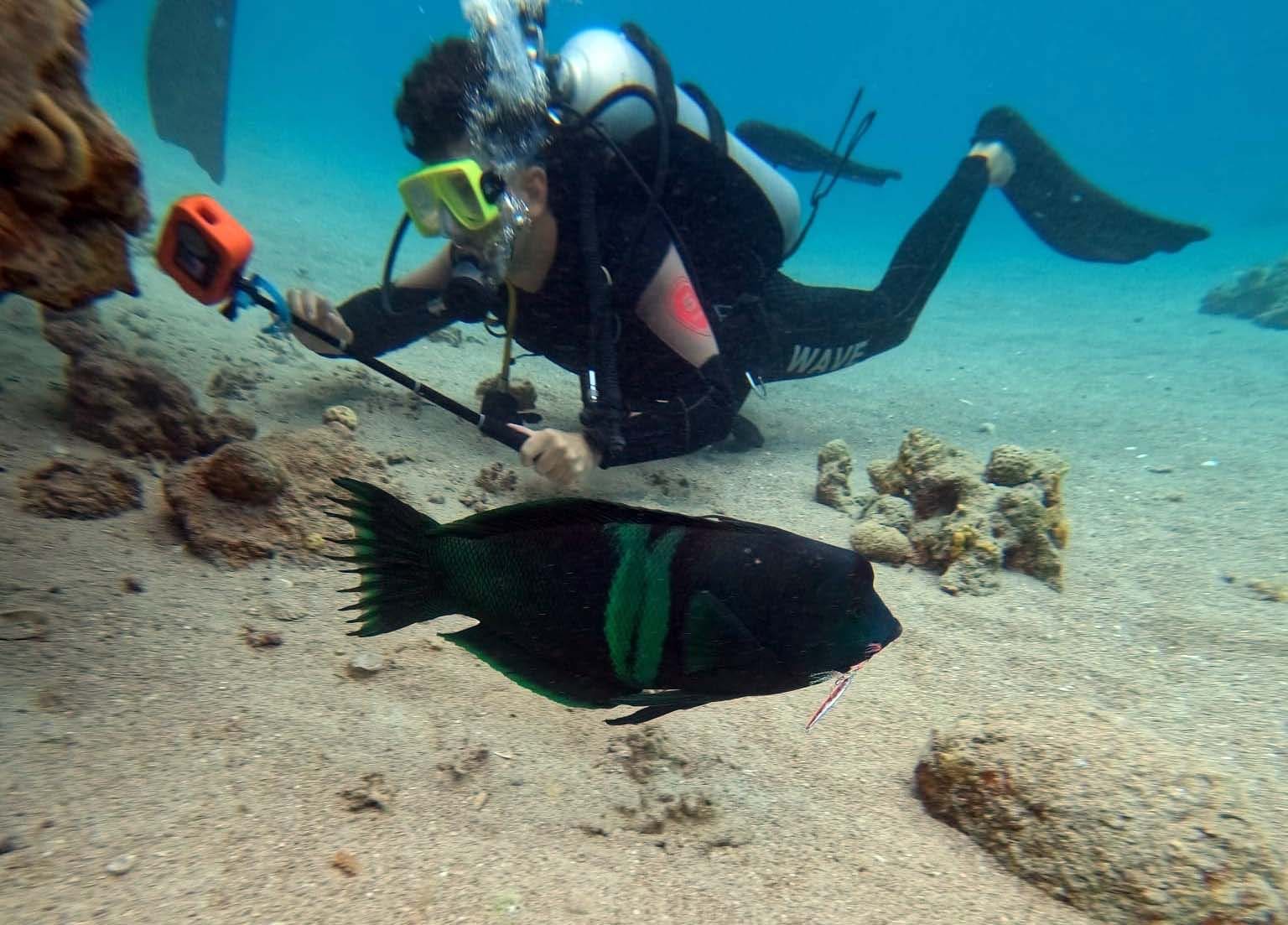
(Haipo) – In a joint rescue operation by inspectors from the Nature and Parks Authority and divers from the Eilat Underwater Observatory Park, a sea otter was rescued after being found with a fishing hook stuck in its mouth in the waters of the Gulf of Eilat. The hook was successfully removed underwater, and the fish was released back onto the coral reef and returned to swimming freely. The operation came after about two weeks of reports and monitoring by dive instructors.
Initial reporting and ongoing monitoring of the injured fish
The story began on October 24, when Rotem Hatuka, a diving instructor at the Aqua Sports Club in Eilat, noticed a Red Sea wrasse carrying a fishing hook in its mouth and a long line dangling from it, near one of the rocks near the shore. Hatuka reported the incident to the Nature and Parks Authority inspectors and continued to monitor the fish, sending reports, photos and videos that helped in attempts to locate it. In the following days, additional reports were received of fish seen in the area with hooks in their mouths. Initial attempts to locate them were unsuccessful, but Hatuka and other diving instructors continued to update the authority personnel on the location of the fish.
The successful underwater rescue operation
Following another report received this week about a sea otter spotted with a large hook in its mouth, Nature and Parks Authority inspectors, together with divers from the Underwater Observatory in Eilat, prepared for another search operation. Omri O'Mosei, the inspector of the Marine Unit at the Nature and Parks Authority, said: "For more than two weeks, we have received reports of fish that were hit by fishing hooks in the area, and we made several attempts to locate them. Thanks to the alertness and perseverance of the dive instructors and the cooperation with the divers from the Underwater Observatory, we were able to locate and save the otter." Aviv Levy, the scientific director of the Underwater Observatory Park, added: "The hook was external, so we were able to remove it on the spot, without the need to bring the fish to the observatory's marine hospital. We were able to remove it successfully, and within a minute of the capture, we had already released it on its way to the coral reef and monitored its movements to ensure that its health was good."
The danger of fishing hooks to marine life and a call for public responsibility
According to Omusi, the case illustrates how dangerous fishing hooks and lines left in the water can be to marine animals, causing serious injuries and even death. Omusi asked the public to be responsible, avoid leaving fishing gear in the sea, and report animals in distress. Levy explained that the Red Sea wrasse is one of the largest in the wrasse family and can reach a length of 80 cm. According to him, at night the fish burrow and sleep in the sand as protection from predators, and their appearance indicates their age and sex: when young, the fish is white with bright orange spots, and when mature, it is dark green with two bright transverse stripes. The adult male has a prominent forehead and feeds mainly on mollusks and crustaceans, thus contributing greatly to the dilution of coral predators on the reef. Levy emphasized that this is a protected nature value, and that in any case where injured marine animals or those that appear to need help are encountered, they should be reported to the Underwater Observatory Park or the Nature and Parks Authority.
Thank you to the diving instructors for their cooperation.
The Nature and Parks Authority and the Underwater Observatory thank Rotem Hatuka and the diving instructors for their vigilance, perseverance, and reports that helped make the rescue a success. Both bodies emphasize the importance of cooperation with the public in protecting marine animals, and call on anyone who encounters a marine animal in distress to report it to the authorized authorities, in order to enable rapid treatment and saving lives underwater.
Did the article interest you?