


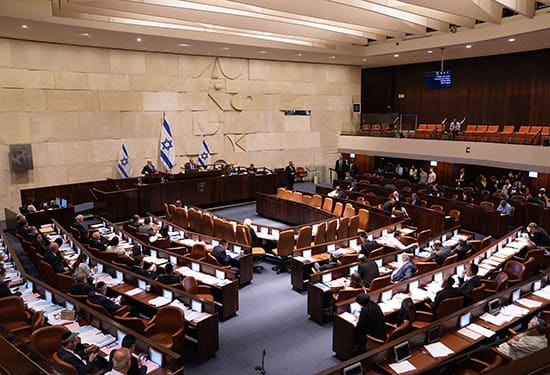
(Hai Fa - Haifa and the surrounding area news corporation) 120 members of the Knesset will be sworn in today (Tuesday, November 10, 2026) for the 26th Knesset, but for residents of Haifa there is another reason to stop and examine the composition of the new Knesset. The third largest city in Israel, the capital of the north and the metropolitan center of the region, is left without a representative or representatives who live there and identify with it.
This morning (Tuesday, November 10, 2026), the term of the 26th Knesset was solemnly opened. 120 members of the Knesset arrived at the Mishkan in Jerusalem to declare allegiance to the State of Israel, in the presence of President Yitzhak Herzog, their families and other guests. The new Knesset will include 46 new members of the Knesset, 33 women, the highest number since the establishment of the state, and alongside them a host of well-known figures, public figures, veterans of the defense establishment, bereaved families and representatives from a wide range of sectors in Israeli society.
Among the notable figures is also the youngest Knesset member in the country's history, Yonatan Shalev, aged 24, and Prime Minister Benjamin Netanyahu, who will begin his 15th term in the Knesset, the longest to date. However, within this diverse human and political mosaic, a significant disadvantage stands out for the north: Haifa has no direct representation in the 26th Knesset.
A city with over 294,000 residents, an economic, academic, industrial, transportation and cultural hub, and serving a large population throughout the Haifa metropolitan area and the north, will be left without representatives in the Knesset who come from the city and naturally represent its municipal interests.
This is not just a question of honor or symbolic representation. This is a city that is facing significant challenges: the future of Haifa Bay, the evacuation of polluting industry, employment development, public transportation, urban renewal, strengthening universities and higher education institutions, development of the Haifa Port, home front security, tourism, culture, and the quality of life of its residents.
The obvious question is who will carry Haifa's voice in the Knesset corridors, in committees, in budget discussions, and in government ministries?
Not from Haifa, but from the north. Who will make it to the Knesset?
Despite the lack of Haifa representation, the Haifa region and the north will be represented in the new Knesset through a number of elected representatives from nearby localities and northern localities. Among the names mentioned in the new composition:
Haifa area and surroundings:
- Kamil Abu Rokan – from Usfiya, from the Yashar Party. A retired major general and former coordinator of government activities in the territories.
- Hamed Amar – from Shfaram, on behalf of Yisrael Beytenu.
- Dr. Maha Karkabi – from Shfaram, on behalf of Balad/the partner, a social researcher and lecturer in the field of sociology and anthropology.
- Yaya Pink – from Yokneam, on behalf of the Democrats, one of the leaders of the struggle for equal burden and someone who was involved in promoting social justice.
Northern settlements:
- Dr. Paten Ghattas – Marama, from Hadash/the Joint Committee, has a doctorate in political science and deals with public health in Arab society.
- Bachar Awauda – from Kfar Kana, on behalf of Balad/the partner, manager and organizational and strategic consultant.
- Ahmed Darvashna – Marina, on behalf of Hadash/the Joint Venture, a lawyer who deals with execution and real estate.
- Dr. Mansour Abbas – from Magar, Chairman of RAAM.
- Aman Khatib – from Nazareth, on behalf of RAAM, social worker.
- Dr. Yasser Hujairat – from Bir al-Makhsur, on behalf of RAAM, holds a doctorate in genetics.
The presence of representatives from nearby communities and the north is certainly important. They may raise regional issues, promote budgets, and work for all residents of the region. However, this does not negate the fact that Haifa itself remains without direct representation.
Do we need a Haifa Knesset member to promote Haifa?
Here an interesting question arises, and perhaps even more important than the lack of representation: Does the fact that there is no Knesset member from Haifa necessarily mean that the city will lose? Will only a representative who was born in the city, grew up in it, or lives in it advance its interests?
The answer is not necessarily yes.
Haifa's history teaches that often ministers and Knesset members who were not from Haifa, but who held senior positions and government authority, were partners in promoting significant projects that changed the face of the city and its future.
The most prominent example is Israel Katz, Who served for many years as Minister of Transportation. During his tenure, strategic projects were promoted in the Haifa metropolitan area, including the reform of the ports and the establishment of the new Gulf Port, the promotion of the metro system, the railway system, the Valley Railway, and the upgrading of transportation routes and connectivity to the northern region.
These are projects of national significance, whose impact on Haifa and the Krayot is still evident today. Of course, these are government projects that were carried out through infrastructure companies, professionals and many entities, and not the result of the activities of just one person. However, the designated minister had a significant influence in their advancement.
Even during the tenure of the Minister of Transportation Miri Regev Important transportation plans in the Haifa metropolitan area continued to progress. Among other things, promoting the expansion of the metro network to Haifa West and Tirat Carmel, plans to upgrade public transportation, promoting the Eastern Bypass and regional connectivity. These are steps taken in cooperation with the Haifa Municipality, infrastructure companies and professional bodies.
Another example is Moshe Kahlon, Former Minister of Finance, Communications and Welfare, who lived and was politically active in Haifa. During his tenure as Minister of Finance, the "Haifa Bay - Valley of Innovation" plan was promoted, which was intended to lead to dramatic change in the bay area: the evacuation of petrochemical industries, the development of residential areas, employment, commerce, tourism and green spaces.
The plan presented in 2019 included a vision for the construction of approximately 83 housing units and approximately 2.1 million square meters of employment and commercial space. It is important to note that this is a long-term plan, and not a completed project, but its very advancement placed the future of Haifa Bay on the national agenda.
Kahlon was also involved in promoting government assistance to residents affected by the Haifa fires in 2016, during the time he served as Minister of Finance.
is also Prof. Daniel Hershkowitz, Former Minister of Science and Technology and a resident of Haifa, he has contributed to the city over the years in the fields of academia, science, and the community. His public and academic activities, alongside his connections with the Technion and city institutions, illustrated the importance of connecting national leadership with local needs.
These examples show that it is not always the Knesset member's residential address that determines the extent of his contribution to the city. Sometimes the ability to influence, the connections in the government, the position he holds, the willingness to fight for budgets, and the ability to turn a vision into a work plan are just as important.
Haifa needs a strong voice, not just a local address
Still, the lack of a Haifa representative in the 26th Knesset is not an issue that can be ignored. Haifa has unique needs that do not always coincide with those of surrounding communities. The city needs someone who will take care of it in budget discussions, raise the issue of Haifa Bay, fight for infrastructure development, strengthen its status as a metropolitan city, and ensure that government decisions are not made without real consideration for the needs of its residents.
Haifa needs connections with government ministries, the ability to influence the national agenda, and someone who knows how to stand by the mayor and the municipal administration when a government decision is required. It is possible that a representative from the north, even if not from Haifa, could do this. It is also possible that a senior minister from a party not affiliated with Haifa would lead significant moves in its favor.
But the lack of representation must not turn into a lack of attention.
The real question is not just who sits in the Knesset and what city they come from, but who will be willing to fight for Haifa, who will take responsibility for its future, and who will turn its needs into plans, decisions, and budgets.
On the day the 26th Knesset gets underway, Haifa should remind all elected officials: Even without a local Knesset member, the third largest city in Israel cannot remain outside the State of Israel's development and investment plans.
Haifa doesn't just need a representative to carry its name. It needs representatives who will act on its behalf and prove it with actions.
Without Haifa representatives in the Knesset building, but with representatives in Haifa
We turned to representatives on the City Council, who constitute a connecting link between local politics and the national parties: Attorney David Etzioni, who serves as a liaison for the Yeshar party headed by Gadi Eisenkot, which is supposed to be part of the next political formation, and Fakhr Bayadsi, deputy mayor for Hadash, which is a partner in the Joint List, which includes 11 Knesset members.
We asked them how they explain the absence of a Haifa voice in the Knesset, whether this is a failure in representing the city's interests, and what it means for the residents of Haifa, who are left without direct local representation in the corridors of power.

Deputy Mayor Fahr Bayadsi, As the third largest city in Israel, it certainly deserves adequate representation in the Knesset. Local representation is a source of pride, honor, and recognition of the city's importance and status. At the same time, it is important to be honest: a member of Knesset does not have to be a resident of Haifa to act on its behalf, just as he does not have to live in the Negev to promote solutions to the housing crisis, land regulation, and construction problems in the Negev.
The central question is not where the Knesset member lives, but rather to what extent he knows the needs, connects with the professionals, representatives, and residents who raise the needs, to what extent he is committed to addressing them, and is able to harness the parliamentary and governmental tools to advance them.
Haifa has suffered for years from significant gaps in the allocation of government resources, especially with regard to its status as a mixed city. Behind the urban socioeconomic index, huge gaps between neighborhoods are hidden. Some of them are dealing with severe social and economic hardship, which is why a differential budgeting policy is required, one that addresses the real needs of each neighborhood and not just the urban average.
The challenges are many and complex: rehabilitating old neighborhoods, urban renewal, public housing, regulating costs and land registration, assisting young couples in purchasing apartments and obtaining mortgages, housing solutions and long-term rentals, improving infrastructure and transportation, and especially protective solutions for old neighborhoods and buildings for preservation, where there are real difficulties in adding protected spaces.
In the field of education, a city master plan is needed that will adapt the layout of educational institutions to the changing demographic reality. The Arab population in Haifa currently lives throughout the city, and therefore educational continuity must be ensured from kindergarten to high school, bilingual education must be expanded, and educational institutions must be strengthened, including church schools, culture, sports, and many other issues, including the evacuation of polluting factories.
Many of these challenges require direct government involvement, dedicated budgets, and cooperation between government ministries, the municipality, and professional and community entities.
We need to work to promote a systematic and professional work plan, based on the real needs on the ground, in continuous cooperation with elected officials, professionals, associations and bodies operating in the city. It is important that members of the Knesset and the factions divide responsibilities among themselves, become deeply familiar with the challenges of the cities involved and work to advance them with government ministries, while setting priorities, clear goals and monitoring and control mechanisms.
Ultimately, a representative from Haifa in the Knesset can certainly be a significant advantage, but in the end what matters is commitment, ability, priorities, and the work plan.
A member of Knesset is elected to serve the entire public, not just the city or town from which he or she came. Haifa deserves representation, but most of all, it deserves action, budgets, equal opportunities, and government policies that recognize its unique needs and provide a real response to them. We will do everything we can to address the needs of the city of Haifa in general and the Arab neighborhoods in particular, to promote solutions and responses to needs.

City Council Member Attorney David Etzioni, He welcomed the trust placed in him and his appointment as the liaison for the Yeshar party, led by Gadi Eisenkot, in Haifa and the metropolitan area. He said this is an opportunity to strengthen the connection between the party leadership and the residents of the region and to connect the needs of the field with decision-makers in the Knesset and the government.
Etzioni emphasized that he intends to be an address available to residents, activists, and party representatives, and noted that he holds a weekly public reception day at the Haifa Municipality under the title "Personal Tuesday with David," with the aim of strengthening the connection and trust with the public. According to him, he prefers to focus on action and building a public infrastructure based on listening and cooperation, rather than on titles.
As for the main issues he intends to promote, Etzioni prioritized the implementation of the government's decision to evacuate polluting industry from Haifa Bay by 2029, which he defined as a historic step of importance to the health and quality of life of hundreds of thousands of residents. Alongside this, he noted the need for investments in transportation, infrastructure, education, urban renewal, employment, and the economic development of the metropolis.
Regarding his political ambitions, including the possibility of running for mayor of Haifa in the future, Etzioni did not hide his desire to influence and lead the city's leadership, but emphasized that one must prove ability, gain trust, and bring results before talking about statements. Finally, he clarified that he intends to work to ensure that the voices of the residents of Haifa and the metropolitan area are heard in Jerusalem, and that the decisions and promises of the central government are translated into action on the ground.
Naama Lazimi can continue to represent us even if she moves to Holon.
Woe to us that this is our representation, she did nothing as a council member or as a member of Knesset for the region.
Let's forget about the residents of Holon who were formerly residents of Migdal HaEmek and simply made a political detour to Haifa.
The current situation is a result of Haifa residents not voting according to local representation, but only politically.
Tilted to the left – and the left for decades, since the Alignment era, has simply seen Haifa "in its pocket"
And all the leftist lists are actually Tel Aviv, the surrounding area, a little bit of Modi'in, Jerusalem, and here and there some Yokneam or Omer.
The situation in which Haifa residents are the willing slaves of a political bloc that is pissing on them is simply embarrassing.