

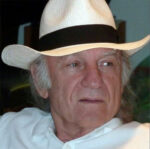
The tour details are based on a recording by our friend Abraham St.
The Bat Galim neighborhood in Haifa was designed by architect Richard Kaufman in 1921. Its uniqueness lies in the fact that it is the only neighborhood in Haifa, and one of the few in Israel, whose houses border the sea. The neighborhood's beaches are particularly popular with water sports enthusiasts, as they are particularly suitable for surfing.
In the years following its establishment, the neighborhood was well-kept and sought-after, and famous families such as the writer Shai Agnon, the Caspi family, Rosenfeld, Margolin, and others lived there. Today, the neighborhood appears somewhat neglected and is home to many new immigrants who are unaware of the neighborhood's glorious past in the days when the swimming pool, casino, cafes, restaurants, and other places of entertainment were operating in the neighborhood.
The tour of the 'Shoresh' group began in front of the casino building, and from there we walked along both sides of the promenade, first to the Navy camp and then to the other side to the cable car station leading to the French Carmel, along the Pinchas Margolin Wharf, who was one of the founders of the neighborhood, and the Rosenfeld Wharf, who was one of the pioneers of shipping in the country.

Despite its neglected skeleton, the casino is still the center of the neighborhood and its symbol. It was built in 1934 and was part of a complete complex that included a restaurant, a ballroom, an Olympic-sized swimming pool, and a regulated beach. The building included columns that were erected in the sea and part of the building's floor was made of glass through which one could see the waves crashing on the beach below. The ground floor served as a cloakroom for restaurant guests and auxiliary rooms for the pool. The building included an event and dance floor and balconies overlooking the sea. The place was considered particularly prestigious, hosting representatives of the British government, tourists from abroad, representatives of various institutions, captains, and wealthy families in general. The casino has since gone through many incarnations and owners, and today it is an abandoned skeleton that we hope will see better days.
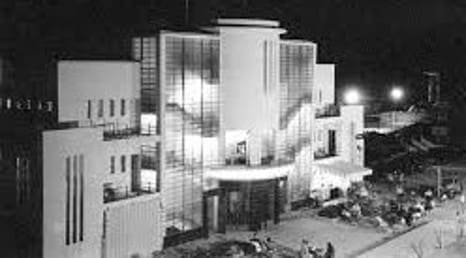
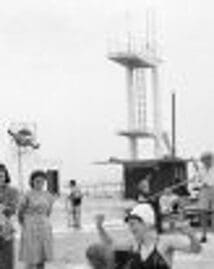
On the far right side of the picture you can see the three-story diving tower for the pool.
From there we continued towards the Navy, pausing near houses with a historical scent that had seen better days. Near the beach we sat and heard about the affair of the illegal immigrant ship 'Haim Arlozorov'. Its original name was 'Ulua' and it was originally an old-fashioned American Coast Guard ship.
In the summer of 1946, she was purchased by a shell company of the Mossad for Aliya B and for three months was prepared and manned in the port of Baltimore by 27 crew members, most of them Jewish volunteers and led by two naval officers from Palestine. Captain Gad Hilev and Chief Engineer Ephraim Tsuk. On her long journey, she picked up Holocaust survivors from Sweden and Italy and during her voyage she was spotted by a British reconnaissance plane and the next morning a fierce battle developed between British takeover teams and the illegal immigrants. The battle lasted three hours.
At the entrance to Haifa Bay, the crew managed to maneuver the ship and 'go ashore'. Since it was right in front of the large British base in Bat Galim, several illegal immigrants who jumped into the water and swam to shore were immediately caught. All the illegal immigrants were deported to Cyprus. On this ship was Luba Eliav, who during that voyage met his future wife Tanya.
While watching the waves, Sinai Grossman, our friend, gave us a scientific lecture on the problem of coastal erosion caused by the movement of ocean waves, by the action of tides, ocean currents or drainage, which leads to coastal erosion, and on all the measures that have been tried to combat this phenomenon. We were captivated.
Israel Kot, an international expert on folk tales and parables, also a dear friend, added and told a scientific story about how Juha dealt with the important task of counting the waves that was assigned to him.
How did the mission come about and was it carried out properly? So one day Juha arrived at the seaside, took off his sandals and began to frolic with the waves of the beach that washed his feet. A group of rascals passing by approached him and, in mockery, promised two copper coins if he managed to count the waves of the sea by evening. Thoughtful wrinkles covered Juha's forehead, who was very eager to earn the two promised coins.
In the evening, the cheerleaders returned, expecting an answer that would allow them to mock and ridicule Juha, but his face became serious and he said to them: "The waves are very similar to man's troubles, more coming than going."
From this point we continued to the other end of the promenade, along which the history of the neighborhood unfolds. We passed old, ancient houses, no two of which are alike. Arab-style houses, Templar-style houses, and even housing estates from the early days of the state.
Among other things, we also saw the house of Captain Steve Hernandorena, who was a Spaniard who helped with the illegal immigration. The writer Shai Agnon also lived in this house at certain times. Towards the end of the promenade, Israel Tamari showed us the concrete pillar left over from an attempt to build another entrance bridge to the neighborhood, which was supposed to pass over the train. The project was stopped under pressure from environmental protection associations, due to its proximity to the water, and only part of the interchange was opened to traffic.
There is no more appropriate place to hear the song of the beach boys who love surfing than on the open beach of Bat Galim, where they usually surf the waves.
We finished the tour as usual with a meal of hummus and a little more at Abu Yusuf's.
The story is not the history of Bat Galim, but rather my childhood experiences in this neighborhood.
The flour station was not part of these experiences and was therefore forgotten.
The flour station was completely forgotten.
So, in honor of our dear friend Mr. Israel Kot, here are my two cents of an update: The Shoresh group tour took place nearly two decades ago. Since then, due to the ridicule of his missions, Juha has had his share, he decided to change careers and join a monastery to become a regular monk. The abbot of the monastery explained to him the strict rule: "You must maintain complete silence - here you are only allowed to say two words every ten years." Juha nodded and said, "I am ready for the challenge."
Ten years pass in complete silence. Juha arrives at the abbot's office. "Two words?" the abbot asks. "The food is bad!" Juha says. The abbot shakes his head from side to side.
Another ten years pass, twenty years have passed, Juha returns to the office. "Two words?" asks the abbot of the monastery. "The bed is hard"!, Juha says.
After thirty years, Juha enters the office again, looking completely exhausted. "Two words?" asks the abbot. "I'm resigning!" says Juha. The abbot throws his hands up in the air and says, "Well, that doesn't surprise me at all! Ever since you got here, you haven't stopped complaining!"
I thank everyone who added details.
A reply to Meir instead and an opportunity for others.
And then they say we are an occupation and go eat at Abu Youssef's.
Among the founders of the Bat Galim neighborhood was Pinchas Cohen. Pinchas Cohen (1886–1956) was an educator, naturalist, and founder of the Haifa Educational Zoo and its first director. He founded the biological institute in the city, still called "Beit Pinchas," from which the zoo grew, and also served as a natural science teacher at the Real School for many years.
The Bat Galim neighborhood was planned by greedy real estate developers as a wall of 30-40-story towers that begins at Zim Square and continues in poor, suffocating density along Second Aliya Street. The neighborhood, which was established in the late 1920s, included a 4-fold increase in the number of residents from before, without any infrastructure for such a large number of residents. It soon became known as the Wall neighborhood. At noon, when the sun passed over the towers towards the mountain, hours of darkness began throughout the rest of Bat Galim, which was imposed by the giant towers. Some called it the Horns Neighborhood because of the giant traffic jams that formed along it during rush hour when thousands of vehicles added to the towers could not get out. Residents of Kiryat Eliezer, who lost their sea view during these years, sued the Haifa Municipality in a precedent-setting lawsuit and won hundreds of millions of shekels in compensation for the decline in value of the large wall built in Bat Galim. That year, it became clear that they would not be able to receive the money because the mayor, who had already accumulated a huge deficit of one billion shekels in his previous terms, managed to double it to 2 billion, and the municipality entered insolvency.